
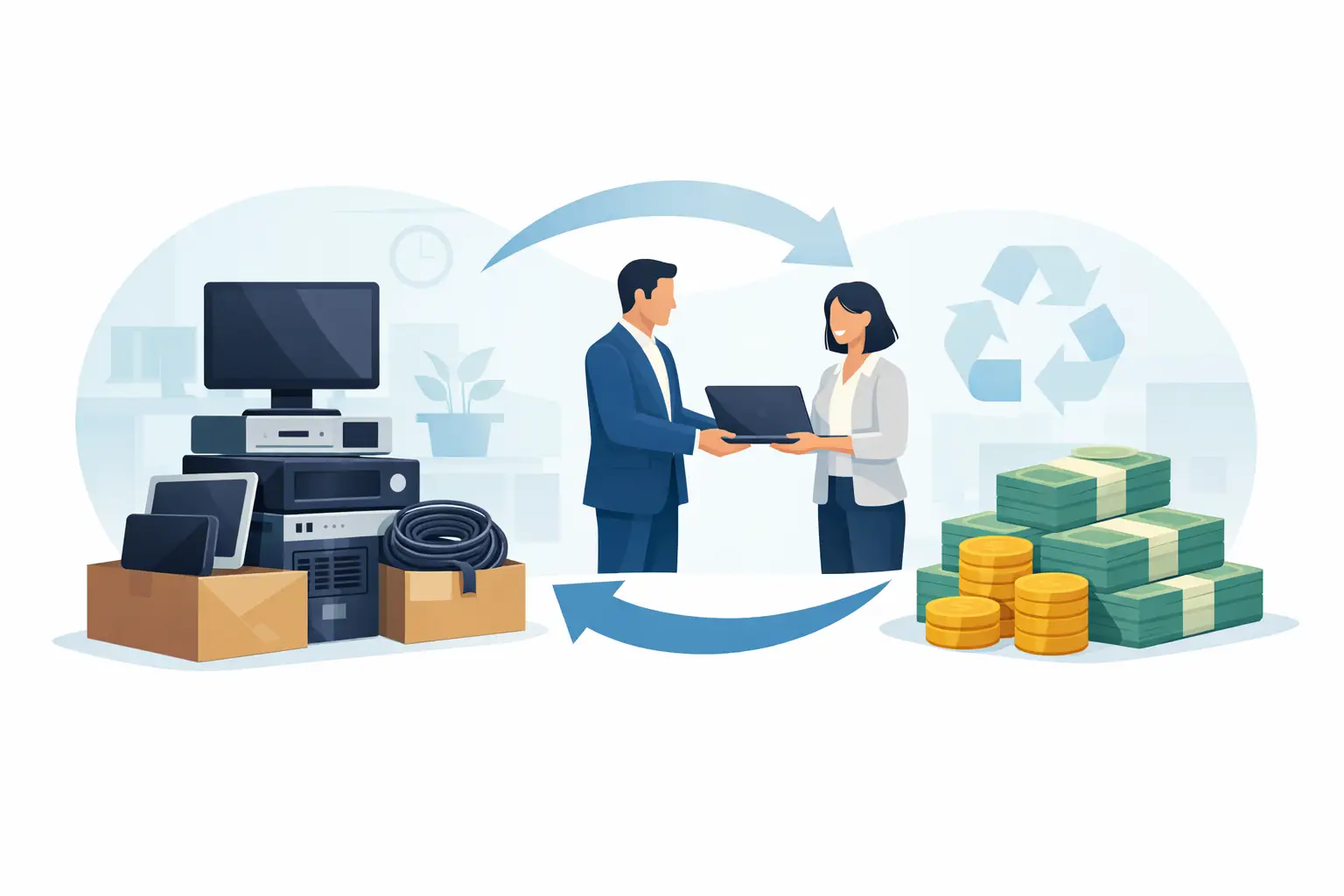
A storage room full of retired laptops, servers, switches, and mobile devices is not just taking up space. It may contain recoverable value, confidential data, and materials that require proper handling. Equipment buyback gives organizations a practical way to evaluate eligible business electronics before sending the remainder through compliant recycling.
For Bay Area offices, schools, nonprofits, government teams, and IT departments, the goal is not to hold onto old equipment indefinitely in case it becomes useful. The goal is to move retired assets out efficiently, protect data, document the process where needed, and recover value when the equipment still has a viable resale market.
What Equipment Buyback Means for Business Electronics
Equipment buyback is the purchase of eligible used IT assets based on their condition, age, specifications, quantity, and current market demand. It is most relevant for business-grade equipment that can be tested, resold, refurbished, or harvested for usable components.
A buyback assessment is not the same as a recycling pickup. Recycling is the responsible downstream process for equipment with little or no resale value. Buyback applies to assets that remain commercially useful. A mixed load may include both: newer laptops and servers that qualify for valuation, plus damaged monitors, outdated peripherals, cables, batteries, and obsolete hardware that should be recycled.
This distinction matters because organizations often assume every retired device has value, or that none of it does. Neither assumption is reliable. A three-year-old business laptop fleet may have meaningful resale potential. Ten-year-old desktop towers with failed hard drives may be more appropriate for secure destruction and recycling.
Which Assets May Qualify for Equipment Buyback?
Eligibility depends on the condition of the equipment and the market at the time of evaluation. Business IT assets typically have the strongest potential when they are current enough to support modern operating systems, are functional, and are available in useful quantities.
Common assets that may be considered include laptops, desktops, servers, network switches, firewalls, wireless access points, tablets, smartphones, enterprise storage equipment, and certain higher-value components. Brand, model, processor generation, memory, storage capacity, configuration, cosmetic condition, and included power adapters can all affect value.
For example, a standardized group of recent business laptops is generally easier to evaluate and process than a collection of unrelated consumer devices. Equipment from a company refresh project may have asset tags, serial numbers, chargers, and consistent configurations. That organization has already done much of the work needed to identify and prepare the assets.
Older CRT monitors, damaged equipment, low-end peripherals, broken printers, empty toner cartridges, and mixed cables rarely drive buyback value. They may still be accepted for e-waste recycling, subject to pickup qualifications and any applicable disposal charges. Large-format printers and copy machines, for example, can require specialized handling because of their size and components.
Quantity and consistency affect the result
A single high-specification laptop can have value, but an organized group of comparable assets is more practical for a business buyback program. Volume helps offset testing, transportation, inventory, data-handling, and resale processing costs.
Consistency also helps. Fifty similar laptops from the same replacement cycle are easier to assess than fifty devices spanning multiple brands, ages, and conditions. That does not mean mixed loads cannot be collected. It means the buyback portion of a mixed load must be evaluated separately from the recycling portion.
Condition is more than cosmetic appearance
Working equipment generally receives stronger consideration than equipment with cracked screens, missing drives, liquid damage, locked BIOS settings, activation locks, or unknown power status. Cosmetic wear is often manageable, but functional defects can reduce value quickly.
Organizations should not spend excessive staff time repairing every device before requesting an evaluation. However, providing an accurate description of known issues helps set realistic expectations. A clear asset list is more useful than a vague statement that a room contains “old computers.”
Data Security Comes Before Resale Value
The resale value of a device should never outweigh the data security obligations attached to it. Retired computers, servers, network appliances, tablets, and phones can retain employee records, customer information, financial data, credentials, proprietary documents, or regulated information even after a user deletes files.
Before equipment enters a buyback or resale stream, organizations need a defined data-handling process. Depending on internal policy, regulatory requirements, and device type, that may involve verified data wiping, drive removal, or physical hard drive destruction. For assets that cannot be sanitized or that contain failed storage media, shredding may be the appropriate path.
This is especially relevant for IT managers and facilities teams coordinating a cleanup across multiple offices. Devices should not be placed in an unsecured loading area while awaiting pickup. Maintain custody, identify the equipment being transferred, and make sure staff understand which devices require special handling.
A practical asset disposition plan should address four questions: who approves the release of equipment, what data destruction method applies, how assets are tracked, and what documentation is required after service. The answers vary by organization. A small office may need a straightforward inventory and secure recycling record, while a healthcare provider, financial firm, school district, or public agency may have more detailed retention and audit requirements.
How to Prepare Assets for a Buyback Evaluation
Good preparation reduces delays and produces a more accurate assessment. Start by separating likely resale candidates from obvious recycling material. If possible, group equipment by type and model rather than stacking everything together in a storage room.
Create a basic inventory with manufacturer, model number, quantity, condition, and whether power adapters or accessories are included. Serial numbers can be useful for internal tracking, though the level of detail should match your organization’s process. Note any equipment that is damaged, locked, missing parts, or known to have failed drives.
Next, identify your data-security requirements before scheduling service. If drives will be removed internally, label and retain them according to policy. If secure wiping or destruction is needed, communicate that requirement in advance. This prevents a common operational mistake: treating data destruction as an afterthought once equipment has already been moved.
Finally, confirm the pickup environment. Identify where the equipment is located, whether there are stairs, elevators, loading docks, security check-in procedures, parking limitations, or palletized materials. A clear site description helps plan a pickup that does not disrupt daily operations.
When Buyback Is Not the Best Option
Buyback is useful, but it is not the right answer for every retirement project. An organization may prioritize speed over resale recovery when it needs to clear a leased office quickly. It may choose destruction and recycling when equipment carries sensitive data and the cost or uncertainty of sanitization outweighs the remaining market value.
The same applies to equipment that is too old, damaged, incomplete, or specialized for a secondary market. Trying to sell each item individually can consume staff time, create inconsistent data-security practices, and leave the least desirable material behind. For most organizations, a coordinated program that combines asset evaluation, data destruction, pickup, and responsible recycling is more efficient than piecemeal disposal.
There is also a timing factor. Used technology depreciates quickly. Holding retired assets for another year can reduce or eliminate their buyback value, particularly for laptops, phones, and network equipment that are replaced on regular cycles. Once a refresh is approved, it is usually better to begin disposition planning early instead of waiting until storage becomes a problem.
Equipment Buyback and Responsible Recycling
A responsible electronics disposition process should account for every category in the load, not only the items with resale value. Eligible assets may move through equipment buyback, while nonmarketable or end-of-life materials are directed to compliant recycling channels. Batteries, storage media, monitors, printers, and other specialized items may require different handling methods.
For organizations in the San Francisco Bay Area, I Got E-Waste can coordinate commercial e-waste pickup, secure data destruction, and evaluation of eligible IT assets. Qualified loads may be eligible for no-cost pickup, while small-quantity pickups and specialized items may involve service fees. Reviewing the equipment list before scheduling helps establish the appropriate service plan.
The most useful next step is simple: inventory what is in storage, identify the data-bearing devices, and separate assets with likely resale potential from material that has reached end of life. That gives your organization a clearer path to recover value where it exists and dispose of everything else responsibly.