
A storage room full of retired laptops, aging switches, dead monitors, and boxed-up accessories usually means one thing: someone needs to decide what still has value and what needs to go. That is where electronics buyback vs recycling becomes a practical business decision, not just a disposal question. For organizations managing end-of-life IT assets, the right path affects data security, compliance, labor, and total recovery.
What electronics buyback vs recycling actually means
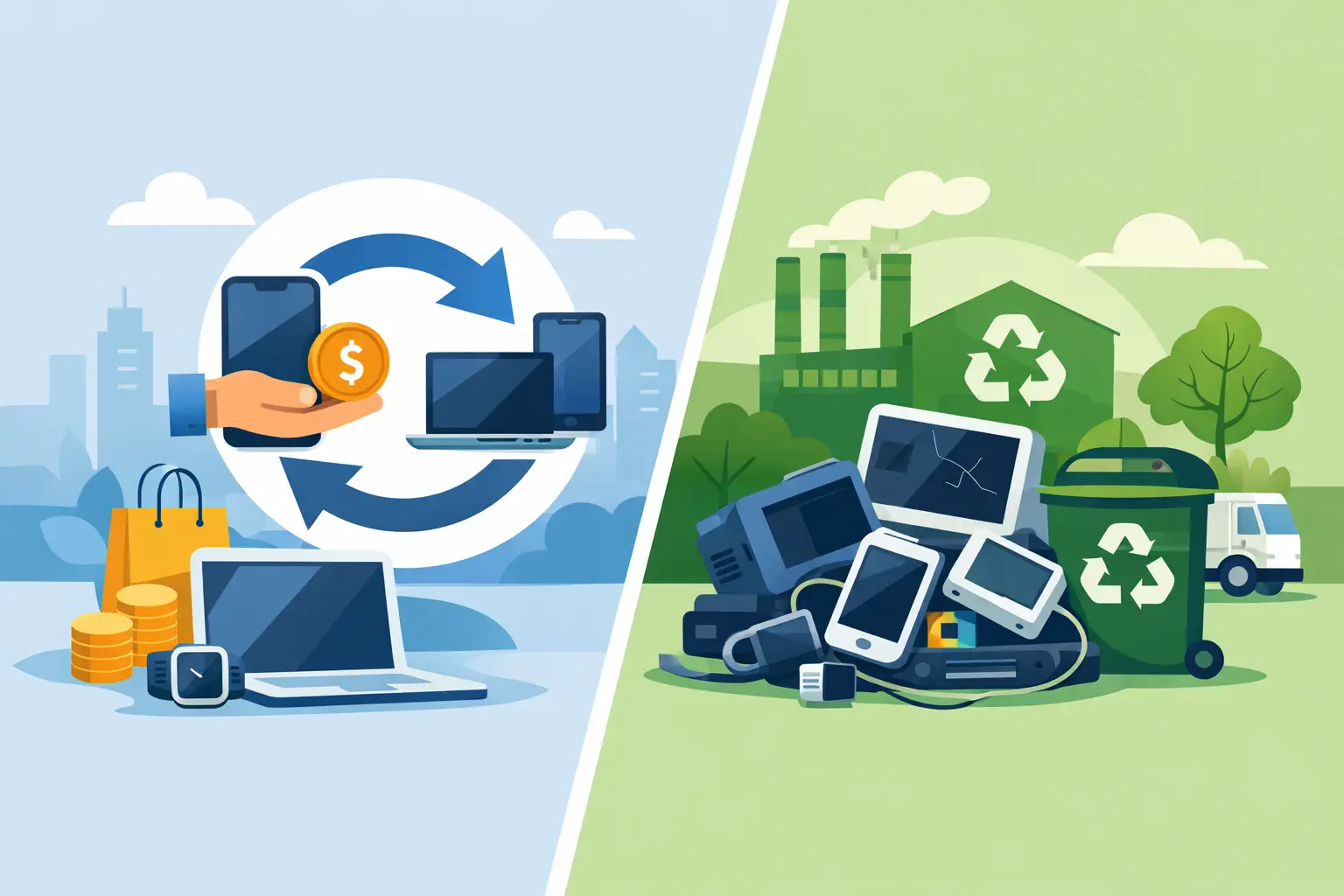
Buyback and recycling are related services, but they solve different problems.
Electronics buyback is for equipment that still has resale value. That usually means newer business-grade devices in reusable condition, such as laptops, desktops, servers, mobile devices, and some networking equipment. If the hardware can be tested, wiped, resold, or redeployed for parts at meaningful value, a buyback program may return money or offset service costs.
Recycling is for equipment that has reached the end of its useful life, has little or no resale value, is damaged, obsolete, incomplete, or not worth refurbishing. The goal is proper downstream handling. Materials are dismantled and processed so metals, plastics, circuit boards, and other components stay out of landfills and out of improper export channels.
For most organizations, the answer is not one or the other. It is usually both. A pickup from a single office or campus often includes some assets with market value and a larger group of devices that should be recycled.
When buyback makes financial sense
Buyback works best when equipment is relatively current, complete, and in quantities that justify testing and remarketing. Age matters, but so do specifications, condition, brand, and market demand.
A three-year-old business laptop fleet with power adapters and consistent models is a strong buyback candidate. The same is true for current-generation servers, switches, and mobile devices that still meet secondary market demand. Devices that power on, have intact screens, and come with known asset information are easier to evaluate and typically worth more.
Volume also matters. A handful of mixed devices may not produce enough recoverable value to support a true buyback. On the other hand, larger lots from office refreshes, lease returns, school upgrades, or data center decommissions often do.
The financial case is not just about resale price. Buyback can reduce internal handling costs if it clears space quickly, lowers warehouse clutter, and shortens the time your team spends cataloging old equipment. In some cases, the recovered value helps offset transportation, processing, or data destruction services.
When recycling is the better choice
Recycling is the better path when the equipment is too old, too damaged, too incomplete, or too low-value to remarket responsibly. That includes broken monitors, obsolete printers, failed hard drives, nonworking desktops, swollen batteries, damaged peripherals, and miscellaneous cables that have no practical resale market.
It is also the right choice when compliance and secure handling matter more than trying to recover a small amount of value. Many organizations would rather clear the material, document disposition, and ensure proper processing than hold obsolete assets for months hoping they can be sold.
This is especially true for regulated environments. Schools, healthcare-related offices, government agencies, nonprofits, and larger employers often need a chain of custody, secure data destruction, and confidence that downstream recycling follows state and federal requirements. In that context, proper recycling is part of risk management.
The biggest mistake: treating all retired IT the same
One common mistake is labeling everything as e-waste too early. Another is assuming everything has resale value. Both create avoidable cost.
If reusable equipment is sent straight to scrap, your organization may lose recovery value. If obsolete equipment is held back for resale that never happens, you lose time, storage space, and operational focus. The right process starts with triage.
That means sorting assets by realistic outcome: reuse or resale, data destruction and buyback, or recycling. A dependable vendor should be able to assess mixed loads without turning the process into a burden for your staff.
Data security changes the decision
In electronics buyback vs recycling, data risk often matters more than commodity value.
Any device with storage should be handled as a security-sensitive asset until proven otherwise. Laptops, desktops, servers, mobile phones, tablets, copiers, and some network equipment may contain confidential business, employee, student, customer, or financial data. Before any resale or recycling happens, that data needs to be destroyed according to your organization’s standards.
This is where many internal disposal plans fall apart. Staff may know equipment has to leave the building, but they do not always have the time, tools, or chain-of-custody procedures to manage drive wiping, shredding, serial tracking, and pickup coordination.
A buyback program only makes sense if the data destruction process is secure and documented. The same is true for recycling. If a vendor cannot clearly explain how storage media is handled, that is a problem regardless of whether the equipment still has residual value.
Compliance is not optional
For business and institutional clients, electronics disposition is not just a facilities task. It is a compliance issue.
California organizations, in particular, need to pay attention to where electronics go, how hazardous components are managed, and whether the recycler follows proper handling standards. Improper disposal can expose an organization to reputational risk and regulatory problems, especially if equipment ends up in a landfill or in poorly controlled overseas channels.
That is why the lowest-cost option is not always the lowest-risk option. A provider that offers clear service terms, accepted item categories, secure collection, and responsible downstream processing usually delivers more value than a vague hauler offering to “take everything.”
For Bay Area organizations managing recurring volumes of obsolete electronics, this matters at scale. A one-time office cleanup is one thing. Ongoing asset disposition across departments, campuses, or multiple locations requires a repeatable process.
How to evaluate equipment before pickup
You do not need a perfect inventory to get started, but a basic internal review helps.
Separate equipment into broad categories. Identify items likely to have value, such as recent laptops, desktops, servers, tablets, and business phones. Then separate clearly obsolete or damaged material like CRT-era equipment, broken monitors, dead accessories, and miscellaneous low-value peripherals. If storage devices are present, flag them early.
Condition notes help. Power status, missing components, cracked screens, asset tags, and model consistency all affect whether a load leans toward buyback or recycling. If you have a large quantity of mixed equipment, photographs and rough counts are often enough for an initial assessment.
The point is not to do the vendor’s job. The point is to avoid surprises and move the process forward faster.
Buyback vs recycling for common business equipment
Laptops and desktops often qualify for buyback when they are newer, complete, and functional. Older units may still be recyclable, but once age and specifications fall below market demand, value drops quickly.
Servers and networking gear can go either way. Enterprise equipment sometimes retains value longer than office workstations, but configuration, generation, and brand are critical. A current switch stack may be marketable. A pile of outdated rack gear may only make sense for recycling.
Monitors are more limited. Standard used monitors usually have lower resale value unless they are newer, higher-end, or in sizable matching lots. Large-format displays, damaged screens, and older units often end up in recycling.
Printers, copiers, batteries, and miscellaneous peripherals are usually recycling decisions, not buyback opportunities. Some of these items also require specialized handling or disposal charges, depending on type and condition.
What a good vendor should help you decide
A qualified electronics processor should be able to tell you, without much drama, what belongs in buyback, what belongs in recycling, and what requires special handling. That includes setting clear expectations around pickup minimums, item eligibility, data destruction options, and any charges for low-volume or hard-to-process items.
For organizations, convenience matters almost as much as pricing. If your office manager, IT lead, or facilities team has to spend weeks chasing answers, the process is already costing too much internally. A practical service model removes clutter, documents disposition, protects data, and helps you recover value where it is actually available.
That is the standard many Bay Area businesses look for when working with a provider such as I Got E-Waste: straightforward pickup coordination, secure handling of data-bearing devices, and realistic guidance on which assets can still return value.
The right answer is usually a mixed strategy
Most organizations should not frame electronics buyback vs recycling as a single choice. A mixed strategy is usually the most efficient approach.
Pull resale value from equipment that still has a legitimate secondary market. Recycle obsolete and damaged material through a compliant processor. Handle all data-bearing assets with secure destruction procedures before they leave your control. That combination protects your organization on cost, security, and environmental responsibility at the same time.
If you are looking at a room full of retired equipment, the useful question is not “Can this all be recycled?” or “Can this all be sold?” It is “Which parts of this load still have value, and how do we clear the rest responsibly without creating more work for our team?”
That is usually where the right decision starts.