

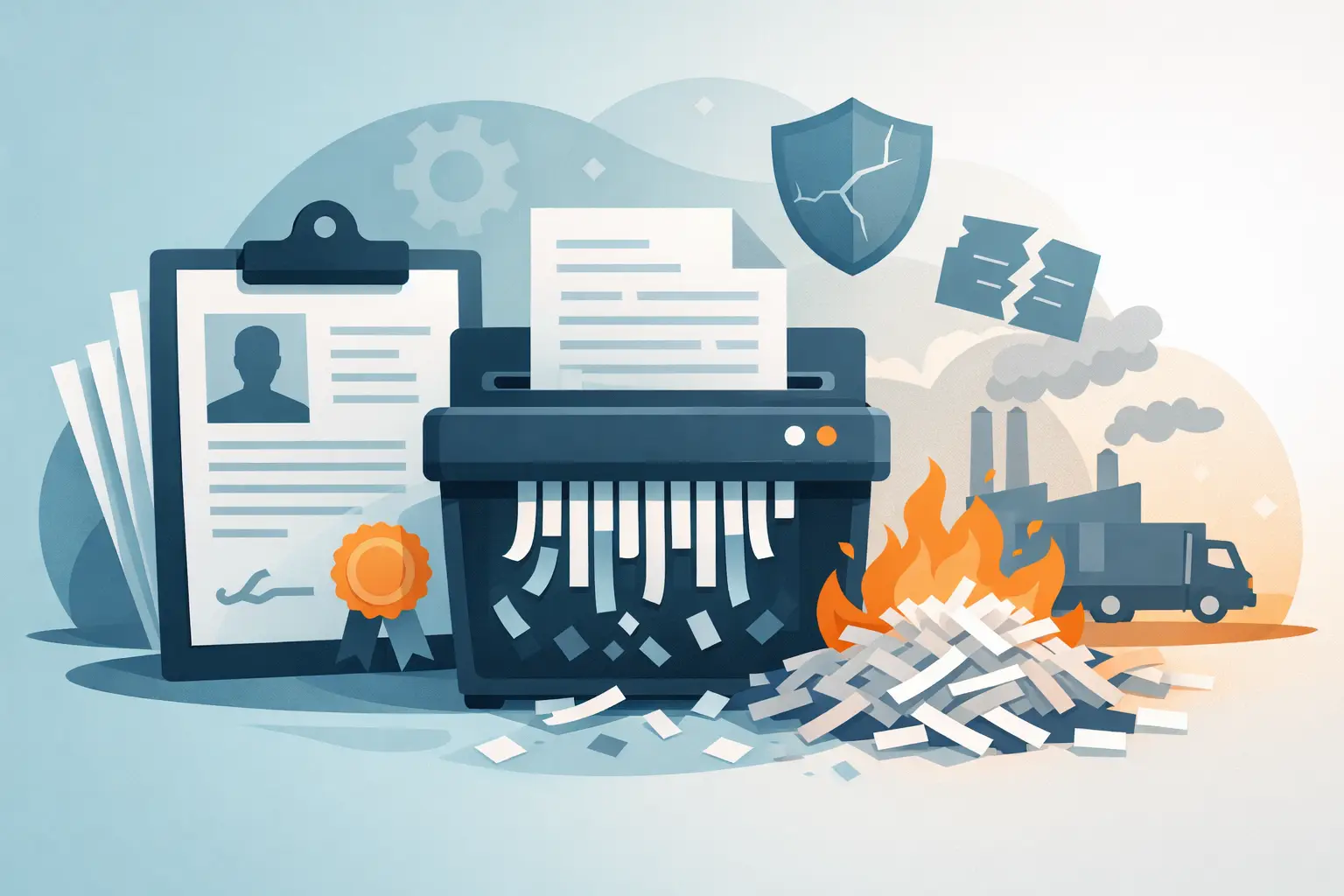
When an old server leaves your office, the real risk is not the hardware. It is the data still tied to that asset and whether you can prove it was destroyed or handled correctly. That is where the question comes up: what is certificate of destruction, and when does your organization actually need one?
A certificate of destruction is a formal document issued by a qualified service provider after materials have been destroyed according to a defined process. In the context of electronics recycling and IT asset disposition, it usually confirms that data-bearing devices, storage media, or other sensitive assets were physically destroyed or securely processed. For many organizations, it is not just a receipt. It is part of the compliance record.
What is certificate of destruction in practical terms?
In plain terms, a certificate of destruction is written proof that specific items were destroyed on a certain date, by a certain provider, using a stated method. If your business is disposing of hard drives, solid-state drives, backup tapes, mobile devices, or retired IT equipment with regulated or confidential information, that proof matters.
The exact scope depends on the service. Some certificates cover physical destruction only, such as hard drive shredding. Others may relate to document destruction, product destruction, or media destruction. In e-waste and data destruction work, the certificate is typically tied to storage media or equipment that contains or once contained data.
This is where many organizations get tripped up. They assume that scheduling a pickup or receiving a basic invoice is enough. Usually it is not. An invoice shows that a service happened. A certificate of destruction is meant to show what was destroyed and support your internal records, audit trail, and risk controls.
Why businesses ask for a certificate of destruction
For an office manager, IT manager, or facilities lead, the issue is accountability. If laptops, drives, or network gear leave the building, someone may need to answer basic questions later. What happened to the equipment? Was the data destroyed? Who handled it? When was it completed?
A certificate of destruction helps answer those questions with something more reliable than email threads or verbal confirmation. It can support internal asset disposition policies, legal hold procedures, cyber insurance requirements, and vendor management standards. Schools, medical groups, financial firms, government agencies, and larger private companies often need this kind of documentation because they handle sensitive information and operate under stricter retention and disposal expectations.
It also helps during leadership turnover. The person who approved a disposal project may not be the person asked about it next year. Good documentation keeps the record with the organization instead of with one employee.
What a certificate of destruction should include
Not all certificates are equally useful. A one-line statement that says materials were destroyed may not give your organization enough detail if an auditor, compliance team, or legal department asks questions.
A solid certificate of destruction typically includes the service provider name, the client name, the date of destruction, and a description of what was destroyed. It should also identify the destruction method, such as shredding, crushing, or another approved process. In many cases, it should reference quantity, serial numbers, asset tags, or batch identifiers when those details are available and relevant.
There is a trade-off here. For large mixed loads, a provider may issue a batch-level certificate rather than listing every item individually. That can be perfectly appropriate, especially for bulk media destruction. But if your internal controls require serial-number tracking for servers, laptops, or drives, you should confirm that level of reporting before pickup is scheduled.
The best time to ask about documentation is before service, not after the truck has already left.
Certificate of destruction vs. certificate of recycling
These two documents are often confused, but they are not the same thing.
A certificate of destruction confirms that specified items were destroyed. In IT disposition, that usually relates to data-bearing media or assets that must be physically destroyed for security or policy reasons.
A certificate of recycling generally confirms that materials were received and processed through an electronics recycling stream. That may be enough for some non-data items such as keyboards, cables, monitors, or peripherals. It is not always enough for devices that store sensitive information.
For example, if your company is disposing of old LCD monitors and broken docking stations, a recycling record may be sufficient. If you are disposing of hard drives from decommissioned servers, many organizations will want a certificate of destruction, often along with chain-of-custody documentation and an itemized inventory when required.
This distinction matters because recycling and destruction serve different purposes. Recycling addresses environmental handling. Destruction addresses security and proof.
When a certificate of destruction is most important
Some disposal projects carry more risk than others. The need for a certificate becomes more urgent when equipment contains customer data, employee records, financial information, protected health information, student records, legal files, or internal credentials.
That commonly includes desktop computers, laptops, servers, network appliances, mobile phones, tablets, hard drives, SSDs, backup media, and multifunction devices with internal storage. Copiers and printers are a frequent blind spot. Many organizations forget that these devices can retain scanned documents, print jobs, address books, and network settings.
It is also important during office closures, relocations, data center cleanouts, and refresh cycles. In those situations, asset volumes are higher, time is tighter, and chain-of-custody mistakes are easier to make. A certificate of destruction does not fix a weak process, but it does document the final result when the process is handled correctly.
What a certificate does not prove
A certificate of destruction is valuable, but it is not magic. It does not automatically mean every compliance obligation has been met. It does not replace internal approvals, asset inventories, or records retention policies. It also does not guarantee that your vendor used the right process unless that provider is actually qualified, transparent, and consistent.
That is the part buyers should pay attention to. Documentation only has value if the underlying service is credible. If a vendor is vague about downstream handling, destruction methods, accepted materials, or chain of custody, the certificate may not give your organization much protection.
In other words, the paper matters, but the process behind the paper matters more.
How to evaluate a destruction provider
If your organization needs certificates for data-bearing assets, ask direct questions. Will the provider issue a certificate of destruction for the specific materials you are turning over? Is the destruction method appropriate for the media type? Can they separate data-bearing devices from general e-waste? Do they provide inventory support or serial-number reporting if your policy requires it?
You should also ask about pickup control and handling procedures. For organizations with recurring cleanouts or multi-site operations, consistency is often more important than one-time convenience. A vendor that can manage scheduled pickups, mixed electronics loads, and secure destruction in one workflow usually creates less administrative friction.
For Bay Area organizations dealing with storage room overflows, retired workstations, and aging network gear, this is often the practical issue. The disposal partner needs to be able to remove equipment efficiently while still producing documentation your compliance or IT team can use.
What to ask for before pickup day
If certificates matter to your business, set expectations in advance. Confirm whether the documentation will be issued per pickup, per project, or per destruction batch. Clarify whether it will cover all electronics or only designated data-bearing assets. If you need item-level detail, say so early.
It is also smart to align your internal teams before scheduling service. IT may care about serial numbers and drive destruction. Facilities may care about clearing space quickly. Finance may care about asset retirement records. Procurement or compliance may care about vendor documentation standards. When those requirements are aligned up front, the disposal process tends to go much smoother.
That is especially true for schools, healthcare groups, multi-office businesses, and public agencies, where one pickup can involve several departments and competing priorities.
The bottom line on what is certificate of destruction
If your organization handles old electronics with sensitive data, a certificate of destruction is proof that designated items were destroyed through a defined process and documented by the service provider. It is a practical record for security, compliance, and accountability, not just an administrative extra.
For some loads, a recycling receipt is enough. For data-bearing devices, it usually is not. The right documentation depends on the equipment, the data involved, and your internal requirements. If there is any doubt, ask before the assets leave your site.
A clean storage room feels good. A documented chain of custody feels better.