
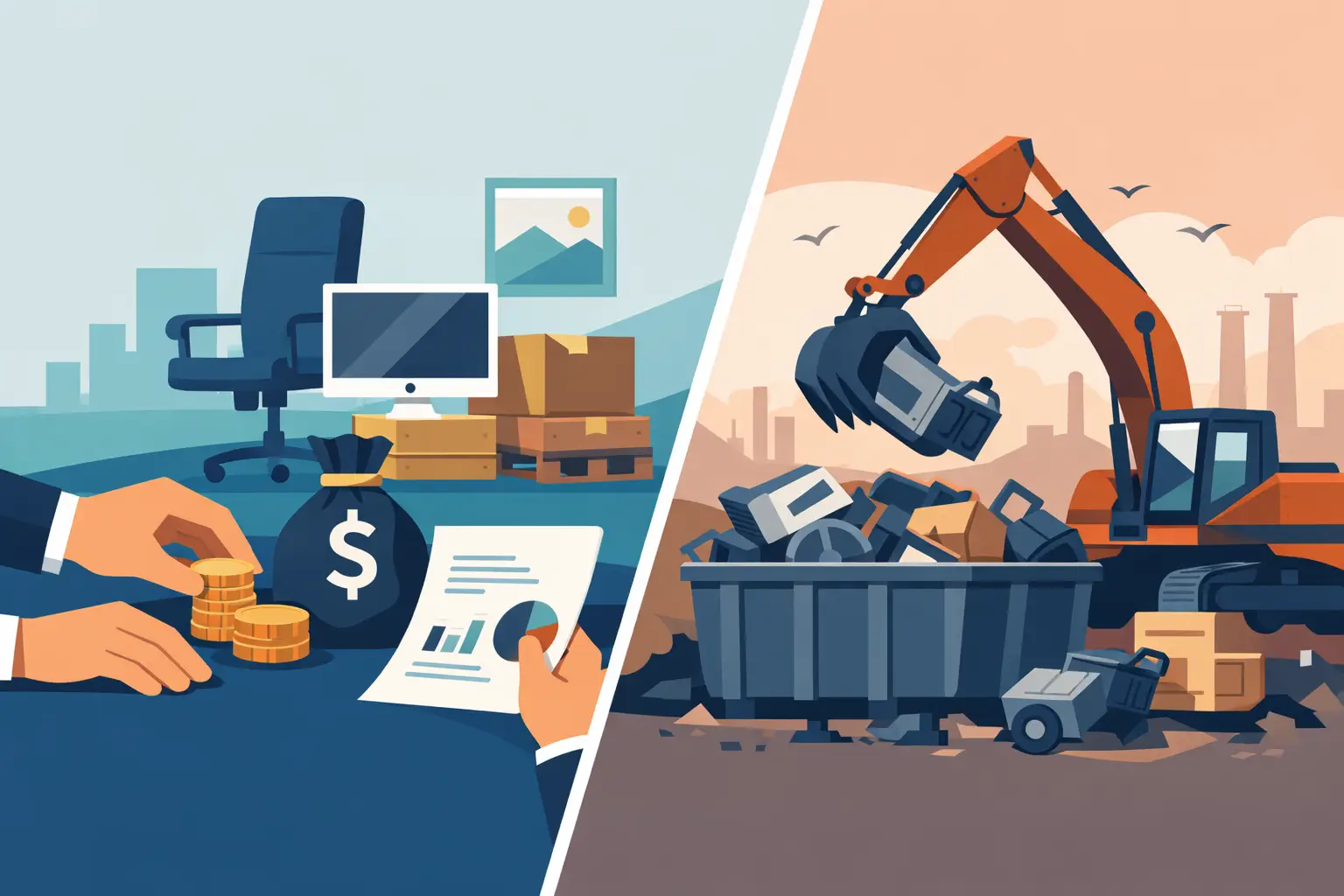
A storage room full of retired laptops, decommissioned servers, and old network switches usually creates two problems at once – lost space and unresolved risk. When organizations compare asset liquidation vs equipment disposal, the right choice depends on what still has market value, what carries data exposure, and what must be handled under recycling and disposal rules.
For Bay Area businesses, schools, nonprofits, and public agencies, this is not just a bookkeeping decision. It affects data security, chain of custody, internal labor, pickup logistics, and whether obsolete electronics are reused responsibly or processed as end-of-life material. Treating all retired IT the same often leads to missed recovery value on one side or compliance problems on the other.
What asset liquidation vs equipment disposal really means
Asset liquidation is the process of recovering remaining value from business electronics that still have a resale, remarketing, or buyback market. This usually applies to newer laptops, desktops, mobile devices, servers, and some network equipment that are functional, repairable, or useful for parts. The goal is straightforward – convert retired assets into partial financial return before the equipment loses more value.
Equipment disposal is different. It focuses on the safe, compliant, and documented removal of electronics that no longer have meaningful resale value or are not practical to remarket. That includes broken equipment, obsolete hardware, mixed peripheral loads, damaged devices, batteries, and older equipment that costs more to test, store, or transport than it is worth.
The confusion comes from the fact that both services can involve the same categories of devices. A five-year-old laptop fleet might still qualify for liquidation if specs are current enough and the units are in usable condition. A similar-looking fleet with failed batteries, cracked screens, missing chargers, or outdated processors may belong in disposal.
When asset liquidation makes sense
Liquidation works best when an organization has equipment with residual value and enough volume to justify evaluation, transport, and downstream resale handling. In most cases, timing matters as much as condition. IT assets lose value quickly, especially laptops, tablets, smartphones, and enterprise hardware tied to changing performance standards.
If your organization is refreshing devices on a scheduled lifecycle, liquidation may be the better path. Equipment that is powered down, inventoried, and removed before it becomes obsolete is easier to evaluate and remarket. Businesses that wait until devices have been sitting for two years usually see lower returns and fewer qualifying assets.
Asset liquidation also makes sense when finance and IT need a more disciplined disposition process. Instead of treating every retired device as waste, they can separate resale candidates from true end-of-life material. That improves cost recovery and reduces the total volume going into recycling streams.
Still, recovery value is rarely uniform. A batch may include some equipment worth buying back and some that should be recycled. That is normal. The practical approach is not choosing liquidation or disposal for the whole load. It is sorting the load accurately.
Common candidates for liquidation
The strongest candidates are generally late-model laptops, desktops, tablets, phones, servers, and network gear with current business utility. Cosmetic wear does not always disqualify a device, but age, functionality, and configuration matter. Missing drives, damaged ports, lock issues, and unsupported hardware can quickly reduce value.
For institutional sellers, complete sets also help. Devices with matching power adapters, clean asset records, and known status are easier to process than mixed piles pulled from multiple closets.
When equipment disposal is the better choice
Equipment disposal is usually the right option when value recovery is low and risk management is the higher priority. If equipment is broken, too old, incomplete, or impractical to test, disposal is often faster and more cost-effective than trying to remarket it.
This matters even more when the load includes data-bearing devices. Hard drives, SSDs, backup media, and embedded storage in printers, copiers, and multifunction devices need secure handling before anything leaves your control. A device with possible resale value still needs data destruction addressed first. If secure destruction requirements are strict, disposal with documented destruction may be the cleaner path.
Disposal also makes sense for mixed electronic cleanouts. Office closures, storage room purges, school lab upgrades, and warehouse reductions often generate a wide range of items – monitors, cables, keyboards, telecom hardware, UPS units, printers, batteries, and older accessories. These loads are usually operational projects, not remarketing projects. The main objective is to clear space quickly, keep materials out of landfills, and document responsible handling.
Compliance changes the decision
For many organizations, equipment disposal is not optional. Certain items require specific downstream processing because of hazardous components, regulated materials, or recycling restrictions. California organizations, in particular, need to pay attention to proper electronics handling, battery management, and vendor practices. The cheapest or fastest option is not always the compliant one.
That is why disposal should not mean throwing equipment away. It should mean managed collection, secure data handling where needed, and documented processing through approved recycling channels.
Data security sits in both categories
One of the biggest mistakes in the asset liquidation vs equipment disposal decision is treating value recovery and data destruction as separate issues. They are connected.
Any disposition plan for computers, servers, storage arrays, phones, and network devices should start with data risk. Before asking what the equipment is worth, ask what information could still be on it. A remarketable laptop with an intact SSD is not ready for resale until data sanitization or physical destruction requirements are met. The same goes for servers pulled from production environments, retired employee phones, and copier hard drives.
In practice, organizations often need a blended process. Some assets are sanitized for resale. Others are physically shredded because internal policy, contractual obligations, or regulatory requirements demand it. That choice can reduce resale value, but it may also be the correct compliance decision.
This is where chain of custody matters. Pickup procedures, inventory controls, and documented destruction are not administrative extras. They are part of responsible asset disposition.
Cost recovery vs total cost
It is easy to focus only on what liquidation might pay back. That can be shortsighted. The better question is total cost.
A liquidation program can recover money, but it also requires coordination. Assets may need sorting, auditing, palletizing, and condition review. If your team spends too many labor hours identifying low-value devices one by one, the gain may disappear. On the other hand, sending resale-worthy equipment straight into recycling can leave money on the table.
Disposal has its own cost factors. Some pickups may qualify for no-cost service based on volume and item mix, while smaller or specialized loads may involve fees. Large-format printers, copy machines, batteries, and certain heavy or complex devices often need special handling. The right vendor should be clear about that upfront.
A practical program weighs labor, storage time, floor space, transportation, data destruction requirements, and downstream handling – not just resale price.
A practical way to decide
Most organizations do not need a theoretical framework. They need a repeatable process. Start by separating equipment into three groups: likely resale, likely recycle, and uncertain. That first pass can be based on age, condition, and whether the item powers on or still meets current business use.
Next, identify anything with data exposure. That includes obvious devices like laptops and servers, but also less obvious equipment such as copiers, firewalls, and some telecom systems. Decide what requires wiping, what requires shredding, and what needs serialized tracking.
Then look at volume and logistics. A few valuable laptops may justify liquidation. A mixed bulk load from an office cleanout may be better handled as disposal with selective value recovery where appropriate. The key is matching the service model to the actual inventory, not forcing all items through one channel.
For organizations with recurring IT refreshes, the best move is to set disposition rules before equipment ages out. Define when devices move from active use to liquidation review, and when they move from liquidation candidates to recycling candidates. That reduces storage buildup and improves both recovery and compliance.
Why a blended approach is often best
In real business settings, the answer is rarely all liquidation or all disposal. Most loads contain both recoverable assets and true e-waste. A capable electronics partner should be able to evaluate mixed inventories, remove data-bearing devices securely, recover value where it exists, and recycle non-remarketable equipment responsibly.
That is especially useful for organizations managing office consolidations, school technology upgrades, and multi-site cleanouts. The operational goal is not to maximize one metric in isolation. It is to clear space, reduce risk, control cost, and document proper handling without creating extra work for internal teams.
For Bay Area organizations dealing with recurring end-of-life electronics, that practical distinction matters more than the terminology. Asset liquidation is about extracting remaining value from qualified equipment. Equipment disposal is about compliant, secure, and responsible handling when value is gone or risk is too high. The right result comes from knowing which assets belong in each path – and acting before the pile gets bigger.