

A box of retired laptops in a storage room does not look urgent until someone asks where the drives went, who handled them, and whether the data was actually destroyed. That is where onsite versus offsite data destruction becomes a practical business decision, not just a security preference. For organizations disposing of computers, servers, mobile devices, and mixed IT equipment, the right choice depends on risk tolerance, compliance requirements, chain of custody, and how the pickup needs to work in the real world.
Both options can be secure. Both can support compliance. But they solve different operational problems, and the wrong fit can create delays, unnecessary cost, or weak documentation.
What onsite versus offsite data destruction really means
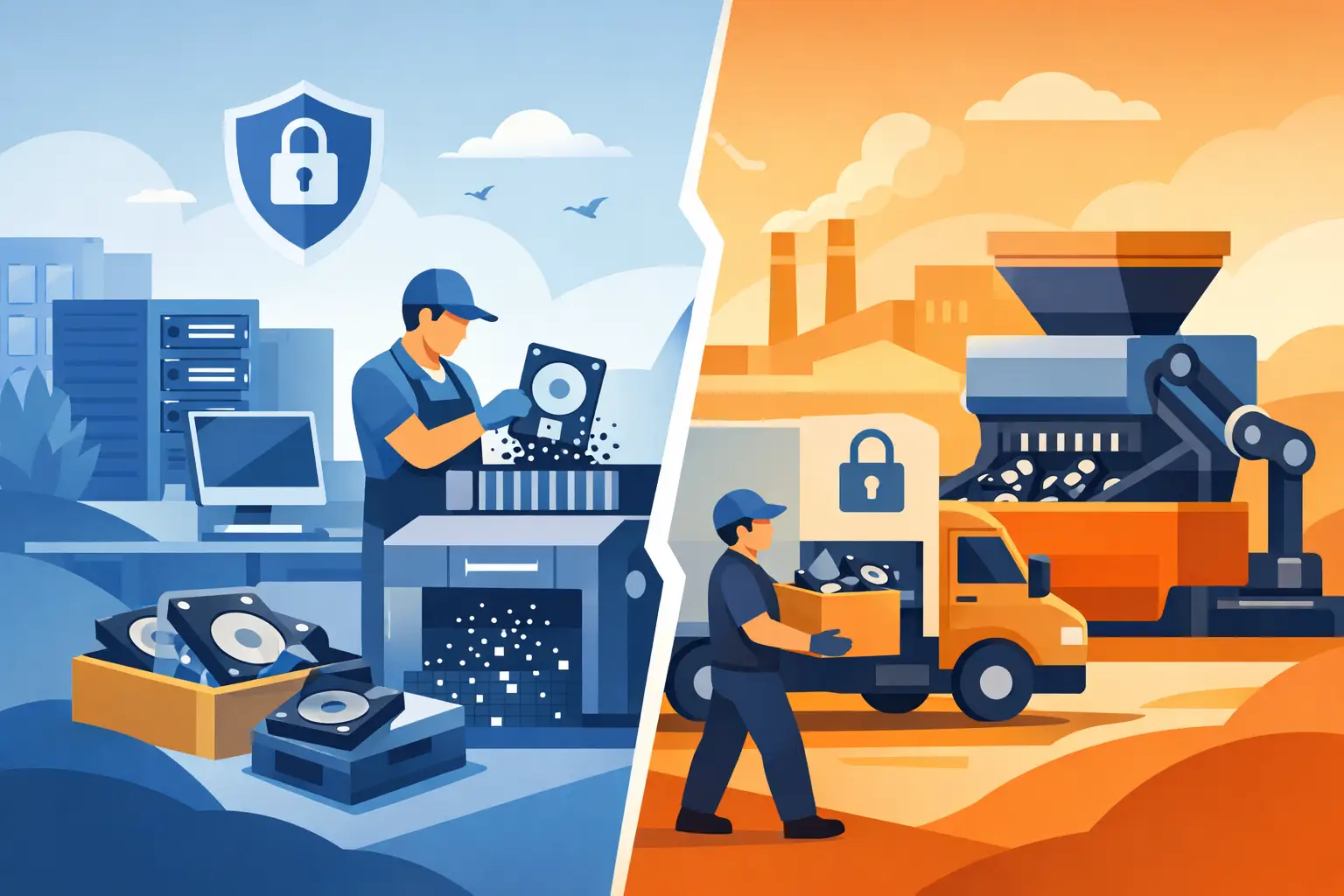
Onsite data destruction means the destruction process happens at your location. A vendor comes to your office, campus, warehouse, or data center and destroys the storage media there, often by shredding or another approved physical method. In some cases, staff can witness the process directly.
Offsite data destruction means the devices or drives are collected, transported under documented chain-of-custody procedures, and destroyed at a secure processing facility. That facility is typically set up for higher-volume handling, controlled processing, and downstream recycling.
The difference is not simply where the work happens. It affects scheduling, staffing, proof of destruction, how quickly space is cleared, and whether your internal team needs to supervise the process.
When onsite data destruction makes more sense
Onsite destruction is usually the better fit when direct control matters more than speed or processing efficiency. If your organization has strict internal data handling rules, legal sensitivity, or a policy that requires witnessing destruction, onsite service can simplify approvals.
This approach is common for organizations handling regulated records, confidential client data, financial information, student records, protected health information, or sensitive government-related materials. If your compliance team wants to eliminate any concern about drives leaving the premises intact, onsite destruction gives a clear answer.
There is also a practical side. Some IT managers and facilities teams do not want end-of-life drives sitting in a loading dock queue or waiting for transport. They want the media destroyed immediately and documented before equipment leaves the building.
That said, onsite service is not automatically the best choice for every load. If you have a large volume of mixed electronics spread across multiple floors or sites, onsite destruction can require more coordination, more on-site access, and more time at the property.
The main advantages of onsite service
The strongest advantage is visibility. Your staff can observe the process, confirm serial tracking if required, and close out internal controls with less ambiguity. For some organizations, that alone is worth the higher service complexity.
Onsite destruction can also reduce perceived chain-of-custody risk because media is destroyed before transport. Once the drives are physically destroyed, the remaining material can move into the recycling stream with less concern about data exposure.
For businesses trying to satisfy internal audit requirements, onsite service may also be easier to explain. The process is concrete, immediate, and easier to document in a way nontechnical stakeholders understand.
The tradeoffs of onsite destruction
Onsite service can be less efficient for mixed loads that include large volumes of monitors, printers, networking gear, and peripherals alongside data-bearing devices. The vendor is working within your site conditions rather than in a dedicated processing environment.
It can also cost more, especially for smaller quantities or jobs that require special scheduling, building access, security escorts, or coordination across departments. If your team assumes onsite is always the most secure and therefore always the right choice, that assumption can lead to paying for a level of control you may not actually need.
There is also the issue of disruption. Trucks, equipment access, staging areas, and witness requirements all take time from your staff. In active offices, schools, and multi-tenant facilities, that can matter.
When offsite data destruction is the better fit
Offsite destruction often makes more sense when the priority is efficient pickup, secure transport, and streamlined processing of a larger or more varied electronics load. If you are clearing storage rooms, retiring equipment from multiple departments, or coordinating a site refresh, offsite service is often the more practical route.
For many organizations, offsite destruction is fully appropriate as long as the vendor maintains documented chain of custody, secure handling procedures, and certificates of destruction where applicable. This is especially true when you are working with an experienced electronics recycler and data destruction provider that already handles commercial pickups and end-of-life asset flows in volume.
Offsite service can also be easier to schedule. Equipment is collected, loaded, and removed quickly, which helps free up space and reduces how long obsolete devices remain on site. For offices, schools, nonprofits, and public agencies dealing with recurring e-waste accumulation, that operational benefit is significant.
Why offsite service is often more efficient
A secure facility is designed for processing. That means controlled workflows, dedicated destruction equipment, and staff whose only job is handling incoming material correctly. In many cases, that environment supports better throughput and cleaner separation between data destruction and downstream recycling.
Offsite service is also useful when the load includes more than just hard drives. If you are disposing of desktops, laptops, servers, switches, phones, cables, batteries, and miscellaneous electronics together, a pickup-and-process model is usually simpler than arranging on-premises destruction first and removal second.
For organizations trying to control disposal costs, offsite service may also be the more economical option, especially when the job qualifies for pickup and does not require specialized on-site destruction logistics.
The tradeoffs of offsite destruction
The obvious concern is transport. Devices leave your site before destruction occurs, so the vendor’s chain-of-custody procedures matter a great deal. If those procedures are weak, undocumented, or inconsistent, offsite destruction becomes harder to defend from a compliance standpoint.
There is also a perception issue. Some stakeholders are uncomfortable with intact drives being moved, even when the process is secure and documented. That concern is not always technical, but it is real. If internal decision-makers need visible assurance, offsite may require more explanation and stronger paperwork.
How to evaluate onsite versus offsite data destruction
The decision usually comes down to four questions.
First, what type of data was stored on the devices? General office files and retired workstations may support one answer. Systems holding regulated, legal, healthcare, finance, or public-sector data may support another.
Second, what does your policy require? Many organizations choose based on habit when they should be checking internal retention, destruction, procurement, and audit rules. If your written policy requires witnessed destruction or specific documentation, that narrows the field quickly.
Third, what does the load look like? Ten failed drives from a secure server room is one type of project. Clearing 300 mixed electronic assets from several departments is another. A method that works well for one can be inefficient for the other.
Fourth, how important is speed at the pickup site? If your team needs equipment gone fast with minimal interruption, offsite may be the better operational fit. If immediate destruction before removal is the priority, onsite may be justified.
Documentation matters more than preference
Whether destruction happens onsite or offsite, the vendor should be able to explain the process clearly and provide the right records. That includes pickup documentation, chain-of-custody controls, and a certificate of destruction when the service calls for it.
This is where many disposal programs fall short. They focus on the destruction method but do not ask enough about handling, transport, labeling, segregation of data-bearing assets, and final reporting. A secure process is not just the moment a drive is shredded. It is every handoff before and after.
For Bay Area organizations managing recurring IT turnover, it is often more useful to choose a provider that can handle the full operational picture: pickup logistics, data destruction, electronics recycling, and compliant downstream handling. That reduces gaps between departments and makes the disposal process easier to repeat.
The practical answer for most organizations
There is no universal winner in onsite versus offsite data destruction. Onsite is often best when direct witness, immediate destruction, or higher-sensitivity controls are required. Offsite is often best when you need efficient removal, secure documented handling, and practical processing of larger mixed electronics loads.
The best choice is the one that matches your actual data risk, your internal policy, and the way your organization needs pickups to work. If those three factors line up, the disposal process gets simpler, cleaner, and easier to defend later when someone asks what happened to the equipment.