
A server rack can be removed from an office in an afternoon. The data on its drives can remain a liability until the organization selects and documents the right destruction method. Physical shredding versus degaussing is not simply a choice between two secure services. The correct method depends on the media type, your internal data-retention rules, whether assets have resale value, and what evidence your auditor or customer requires.
For Bay Area organizations retiring desktops, servers, backup media, and network equipment in volume, the goal is straightforward: prevent data recovery, maintain chain of custody, and send materials through responsible downstream recycling. The method should support all three.
What Physical Shredding Does
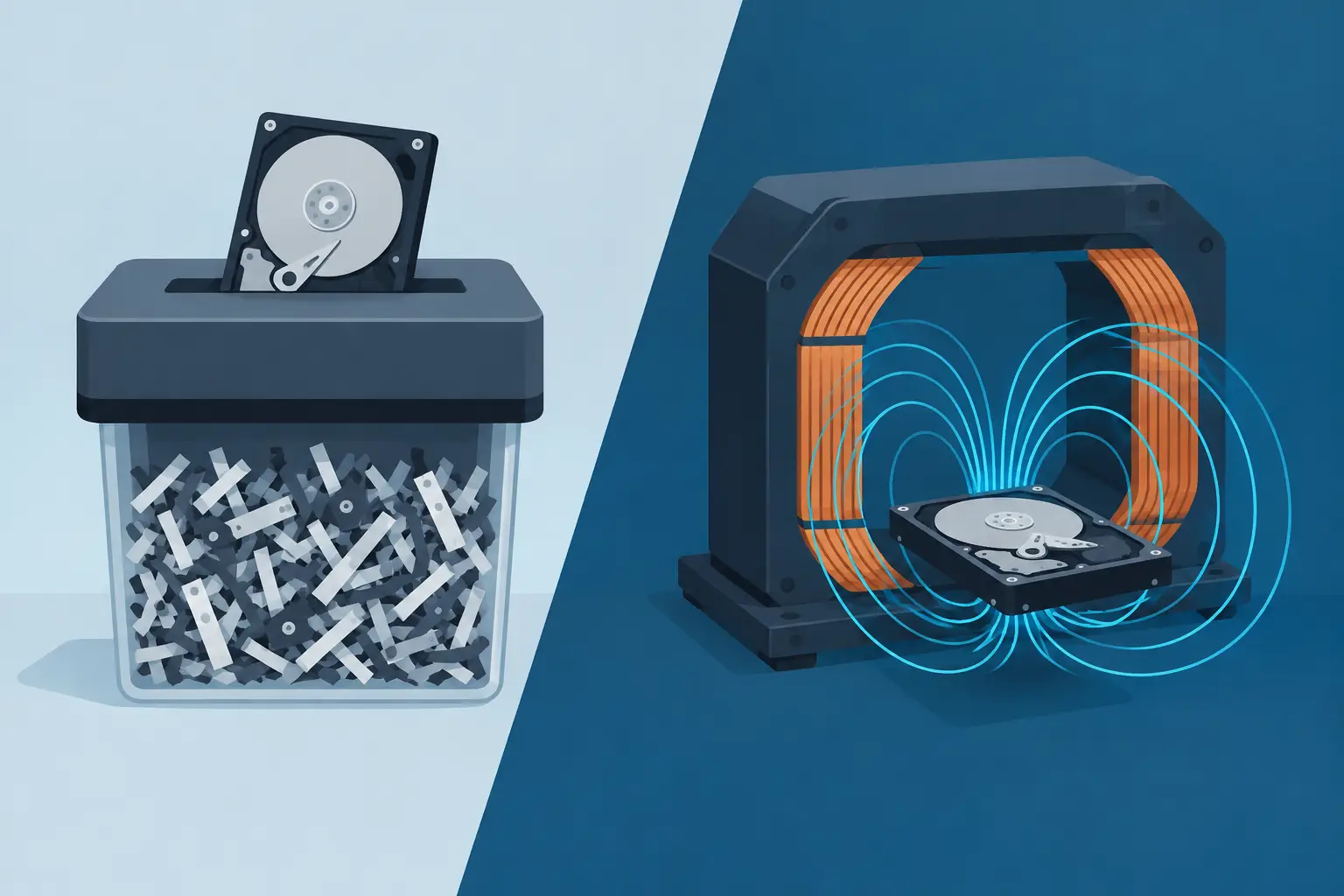
Physical shredding destroys a storage device by cutting, tearing, or crushing it into small pieces with industrial equipment. Once a hard drive, solid-state drive, USB device, or mobile device storage component has been reduced to appropriately sized particles, reconstructing the device or reading its data is not practical.
Shredding is widely used because it applies to many media types. It is effective for traditional hard disk drives, solid-state drives, flash drives, memory cards, smartphones, optical media, and magnetic tapes. This broad compatibility matters when an IT closet contains mixed equipment from several refresh cycles.
The process is also easy to explain to stakeholders. A physically destroyed drive cannot be put back into service or resold. For organizations handling regulated information, that finality can simplify disposition decisions. It removes the question of whether an old device was properly wiped before it left the building.
There are trade-offs. Shredding eliminates reuse value and requires responsible separation and recycling of the resulting metal, plastic, circuit-board, and battery materials. It is also not a substitute for inventory control. A destruction certificate is useful, but it should be supported by a documented chain of custody and, when needed, an asset list tied to serial numbers.
What Degaussing Does
Degaussing uses a powerful magnetic field to disrupt the magnetic patterns that store information on certain media. It can be an effective destruction method for magnetic hard drives and magnetic tape when the equipment is designed for the specific media being processed and operated correctly.
A properly degaussed hard drive is generally no longer usable. The magnetic field can erase not only user data but also information the drive needs to operate. That makes degaussing a destruction method, not a way to prepare hard drives for resale or redeployment.
Its main limitation is media compatibility. Degaussing does not destroy data on solid-state drives, USB flash drives, memory cards, smartphones, or other flash-based storage. These devices do not store information magnetically. Applying a degausser to them does not provide a reliable sanitation result.
That distinction is increasingly relevant. Many newer laptops, servers, tablets, firewalls, and mobile devices use SSDs or embedded flash storage. An organization that relies on degaussing alone can create a gap in its data-destruction program if its retired inventory includes nonmagnetic media.
Physical Shredding Versus Degaussing: Key Differences
The most practical difference is scope. Physical shredding can address both magnetic and flash-based media, while degaussing is limited to magnetic media. For a mixed load of retired technology, shredding often offers a simpler operational path because staff do not need to sort every device into a magnetic or nonmagnetic destruction stream before service.
Degaussing may still be appropriate for large quantities of magnetic backup tapes or hard drives where an organization has established procedures and needs a magnetic-media-specific approach. It can process eligible media efficiently, but it requires confidence that the media is truly magnetic and that the degausser meets the required field strength for that format.
Neither method preserves the value of the storage device. If reuse or asset liquidation is a priority, the organization should separate viable equipment before selecting a destruction path. Devices chosen for resale or redeployment need a verified data-sanitization process suited to their storage technology, not degaussing or shredding.
The table below is not necessary to make the decision: magnetic tape and conventional hard drives may be candidates for degaussing or shredding; SSDs, flash drives, memory cards, and mobile devices require physical destruction or another validated flash-media sanitization method. When media types are uncertain, physical destruction provides a more consistent result.
Choose the Method Based on Your Actual Inventory
Before scheduling data destruction, identify what is in the retired equipment. A desktop tower may contain a conventional hard drive, an SSD, or both. A server may have multiple hot-swappable drives. A copier or multifunction printer may contain an internal drive that staff overlook. Network appliances, voicemail systems, point-of-sale equipment, and security systems can also retain data.
This review does not need to delay a pickup. It should give the destruction provider enough information to plan the service correctly. A practical asset inventory should capture device type, storage-media type when known, quantity, and serial number when your policy or contract requires serial-level reporting.
For many organizations, the following situations point clearly toward physical shredding:
- The load includes SSDs, flash media, phones, tablets, or mixed and unidentified storage devices.
- The organization needs irreversible destruction for sensitive customer, employee, financial, healthcare, legal, or government-related data.
- Equipment has no resale value, is damaged, or has reached the end of its useful life.
- Internal policy requires destroyed media before electronics enter the recycling stream.
Degaussing can be a sound choice when the inventory is limited to eligible magnetic hard drives or tapes, the media is properly identified, and the organization understands that the media will not be reused afterward.
Security Is More Than the Destruction Event
A degausser or shredder is only one part of a defensible process. The period between removing equipment from service and completing destruction is where many avoidable problems occur. Drives stored in an unlocked loading area, mixed with general e-waste, or handed off without documentation can expose an organization even if the final destruction method is effective.
A workable process assigns custody from the time equipment is collected. It records what was received, keeps storage devices secured during transport and staging, and provides documentation after destruction. Depending on the organization’s requirements, that documentation may include a certificate of destruction, date, method, quantity, and serial-number reporting.
Ask direct operational questions before selecting a vendor. Will drives be destroyed on-site or transported to a secure facility? How are materials secured in transit? Can the provider distinguish between hard drives and SSDs? What reporting is available? What happens to shredded material after destruction? Clear answers matter more than broad claims about security.
Consider Reuse Before Destruction
Not every retired device should be shredded. A recent laptop, server, switch, or workstation may still have market value after data has been sanitized through an appropriate, verifiable process. Recovering that value can help offset refresh costs and keep usable equipment in service longer.
The decision should be made deliberately. Assets approved for resale or reuse need one workflow. Media designated for irreversible destruction need another. Combining the two without clear labeling creates confusion for IT staff and can result in either unnecessary destruction of valuable assets or accidental release of equipment that was meant to be destroyed.
This is especially useful during office moves, data-center cleanouts, and large technology refreshes, when asset condition varies widely. A provider that handles both data destruction and electronics recycling can help keep those streams separated from pickup through final processing.
Build the Requirement Into Your Disposal Plan
The best method is the one that matches your media, risk level, and documentation requirements before equipment starts accumulating in a storage room. For mixed electronics or flash-heavy inventories, physical shredding is usually the more universal option. For confirmed magnetic media, degaussing may fit an established destruction program.
If your organization is clearing out retired IT equipment in the San Francisco Bay Area, prepare a basic inventory, identify any devices that may be reused, and set aside all media requiring destruction. That small amount of preparation makes secure pickup, documented destruction, and responsible recycling much easier to manage.