
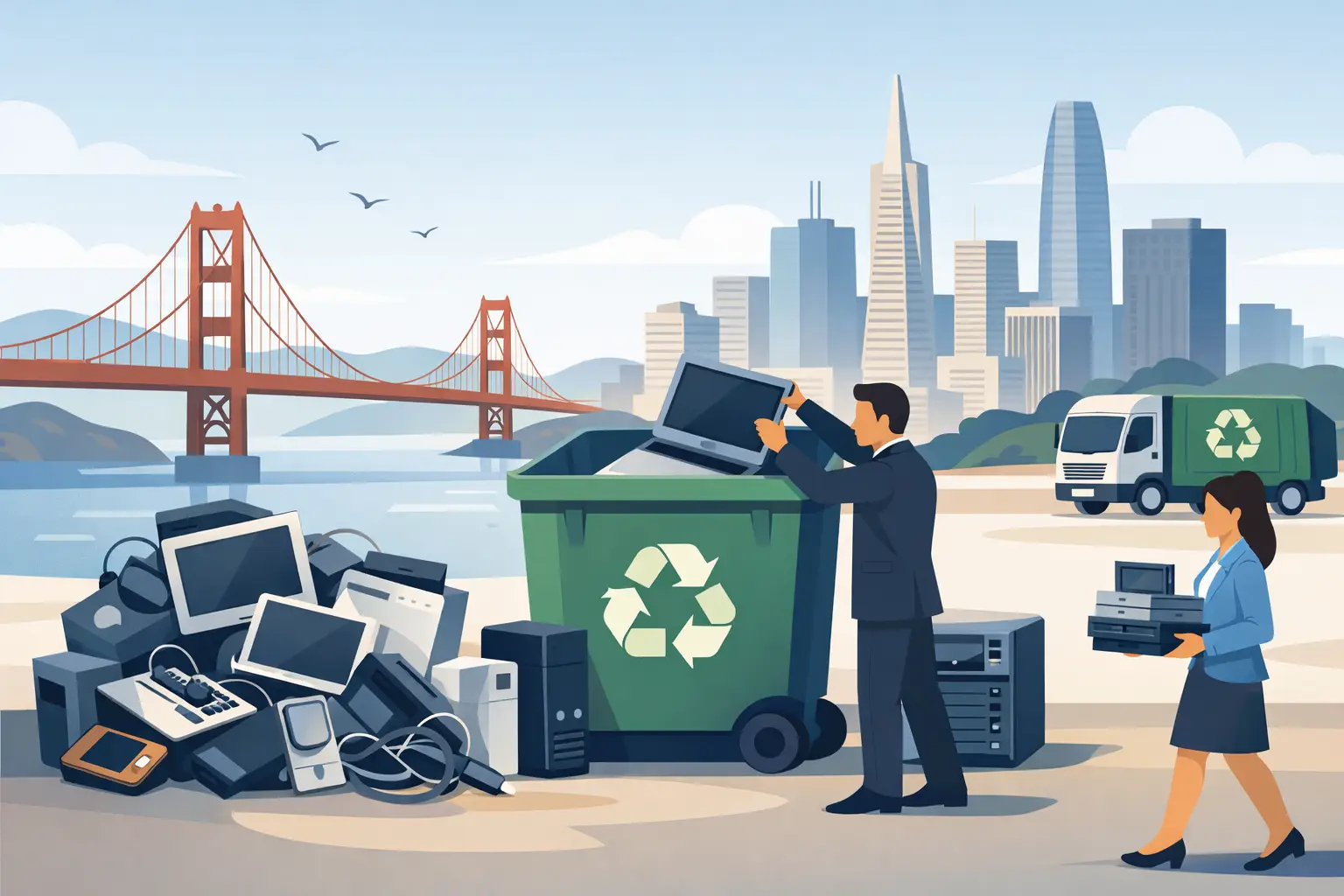
A locked storage room full of retired laptops, dead monitors, old switches, and swollen batteries is not just a space problem. For many organizations, San Francisco e-waste becomes a compliance issue, a data-risk issue, and eventually an operations issue. The longer obsolete equipment sits on-site, the harder it is to track what is there, what still holds data, and what can be safely moved out.
For offices, schools, nonprofits, medical practices, and public agencies, the real question is not whether to recycle electronics. It is how to do it in a way that is secure, documented, and practical for day-to-day operations. That means matching the type and volume of equipment to the right pickup and destruction process, not treating every load of end-of-life electronics the same.
What San Francisco e-waste usually includes
Business e-waste is rarely a neat stack of desktop towers. More often, it is a mixed load built up over time across departments, storage closets, and remote locations. It may include computers, servers, networking gear, phones, tablets, cables, docking stations, printers, accessories, batteries, and miscellaneous peripherals that were kept “just in case” and never used again.
Some of those items are straightforward to recycle. Others need extra handling. Hard drives and solid-state drives raise obvious data security concerns. Batteries require proper segregation and transportation. Larger items such as copiers and large-format printers can change the cost and logistics of a pickup. A simple cleanout can quickly turn into a project if no one has inventoried the load in advance.
That is why commercial e-waste recycling works best when it is treated as an operational task, not an afterthought. The organization needs a clear understanding of what is leaving the site, whether any items need destruction before recycling, and whether the load qualifies for free pickup or requires a fee-based service call.
Why business e-waste needs a different process
Consumer drop-off options exist, but they are not built for organizations disposing of dozens or hundreds of assets at once. A business or institutional load usually needs scheduled pickup, chain-of-custody awareness, and a vendor that understands regulated handling requirements. It also needs minimal disruption. IT managers do not want disposal day interfering with network changes, office moves, or refresh cycles.
There is also the issue of accountability. If equipment contains storage media, organizations need to know whether devices are being remarketed, dismantled, shredded, or processed under a documented destruction workflow. “Recycled” is not specific enough when the devices once stored employee records, client files, financial data, or internal communications.
San Francisco organizations are also operating in a state with strong environmental expectations. Electronics cannot be treated like ordinary trash. Improper disposal creates legal exposure and reputational risk, especially for schools, healthcare providers, public agencies, and companies handling confidential information. A compliant recycler helps reduce that risk by keeping materials out of landfills and out of informal downstream channels where devices may be exported or mishandled.
Secure data destruction is part of the job
For many organizations, the most sensitive part of San Francisco e-waste disposal is not the recycling itself. It is the data. Desktops, laptops, servers, phones, backup devices, and loose drives can all retain recoverable information if they are not properly sanitized or physically destroyed.
The right approach depends on the asset. In some cases, data wiping may make sense for devices with resale value and clear internal disposition rules. In other cases, physical destruction is the better choice, especially for failed drives, damaged devices, or equipment holding regulated or highly sensitive data. There is no one-size-fits-all answer. A finance office, a school district, and a startup closing a satellite office may all have different destruction standards.
What matters is that the decision is made intentionally. If an organization cannot verify that storage media has been sanitized or destroyed, it should assume there is still a risk. That is why secure data destruction and electronics recycling are often handled together rather than as separate projects.
When shredding makes more sense than wiping
Wiping can be effective when drives are functional, accessible, and slated for reuse or resale. Shredding is more direct when devices are broken, encrypted but unverified, or too time-consuming to process individually. It also simplifies internal sign-off for organizations that need a clear end point for storage media.
That trade-off matters in larger refresh cycles. If an IT department is decommissioning several racks of aging equipment, wiping every drive may not be worth the labor if the priority is fast removal and final destruction. On the other hand, high-value assets may justify a more selective workflow if liquidation or buyback is part of the plan.
Pickup logistics matter more than most teams expect
The practical side of e-waste is often where projects stall. Equipment is spread across floors, buildings, or campuses. Some items are boxed, others are loose, and no one is fully sure what is in storage. Then the team finds out that pickup pricing depends on volume, item mix, access conditions, or whether oversized equipment is involved.
A straightforward pickup process solves that early. The organization should know what qualifies for no-cost removal, what requires special handling, and whether there are minimum volume thresholds. This is particularly useful for offices that generate recurring e-waste but not always enough for immediate service. Planning around equipment refreshes, moves, and quarterly cleanouts can make the process more efficient and less expensive.
Access also matters. Freight elevators, loading docks, security check-in procedures, and limited pickup windows can all affect scheduling. In busy San Francisco buildings, a recycler that is used to commercial pickups can save a facilities or operations team a lot of back-and-forth. The goal is to remove material quickly without turning the disposal project into a day-long internal event.
What to separate before a commercial e-waste pickup
Most organizations do not need a perfect itemized manifest before scheduling service, but they do benefit from sorting a few categories in advance. Devices with storage media should be identified. Batteries should be kept separate from general equipment if possible. Large specialty items should be called out early. Anything that may fall outside standard accepted categories should be disclosed before the truck arrives.
This does two things. First, it helps confirm whether the load meets pickup requirements and whether any special charges apply. Second, it prevents delays on-site. A smooth pickup usually starts with a realistic description of the material, not a rough guess.
For internal teams, this is also a good moment to confirm ownership and approval. Old electronics often sit because no department wants to make the final disposition call. Once finance, IT, facilities, or administration agrees that the assets are retired, removal gets much easier.
The environmental side is not separate from compliance
Organizations sometimes frame recycling as a sustainability initiative and data destruction as a security initiative. In practice, they are connected. A qualified e-waste partner should be able to handle both responsibly, because improper downstream recycling can create its own compliance concerns.
That is especially relevant with mixed electronics loads. Monitors, circuit boards, batteries, and other components contain materials that require proper processing. Sending those items to landfill is not an acceptable disposal strategy, and handing them off to poorly controlled channels creates unnecessary exposure. Responsible recycling means documented handling, lawful processing, and a clear commitment to keeping materials out of waste streams where they do not belong.
For organizations with internal ESG or procurement standards, that matters beyond basic disposal. It supports the broader expectation that retired equipment is managed in a way that aligns with legal obligations and internal policy, not just removed from sight.
Choosing a San Francisco e-waste partner
The right vendor is not just the one that says yes to pickup. It is the one that can explain what happens next. That includes accepted item categories, pickup thresholds, data destruction options, any fees for low-volume or specialty equipment, and how the material will be processed after collection.
For most commercial clients, convenience and compliance are the deciding factors. If a recycler can pick up qualifying loads, remove clutter efficiently, destroy data-bearing devices securely, and process electronics under established guidelines, the internal team can close the project with confidence. If those answers are vague, the low quote or fast availability may not be worth the uncertainty.
I Got E-Waste serves Bay Area organizations that need that process to be simple and defensible. That is often what matters most when an office manager, IT lead, or school administrator is trying to clear space, reduce risk, and move on to the next task.
Old equipment tends to linger because disposal feels easier to postpone than to organize. In reality, the cleanest time to handle it is when the problem is still manageable, the asset list is still familiar, and the data risk has not had months to sit forgotten in a closet.