

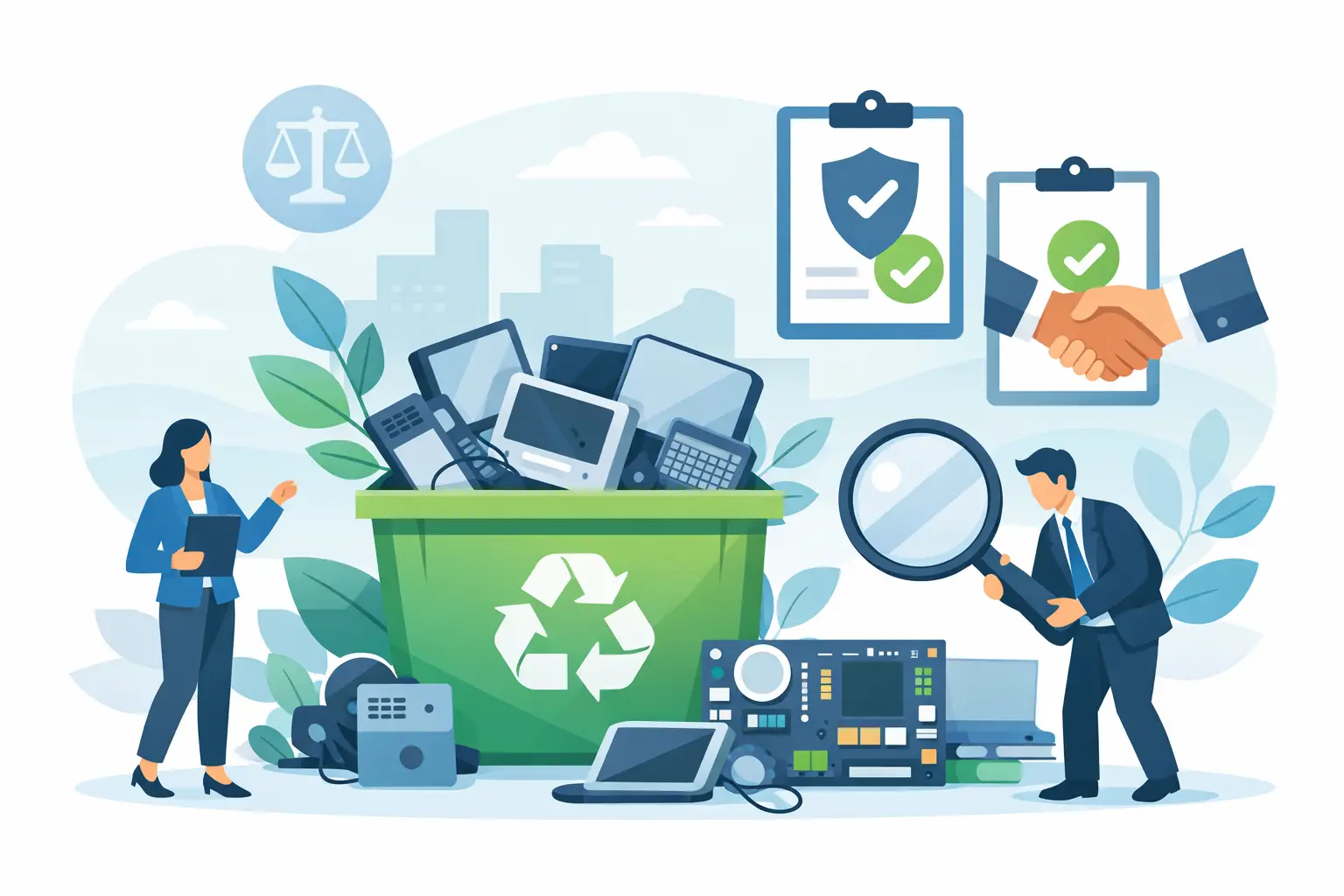
A storage room full of retired laptops, dead printers, and decommissioned network gear is not just a space problem. It is a compliance problem, a data security problem, and often a procurement problem once disposal deadlines start slipping. That is why compliant e-waste vendor selection matters long before a pickup is scheduled.
For most organizations, the wrong vendor does not fail in obvious ways at the start. They answer the phone, quote a pickup, and promise to handle everything. The gaps show up later – unclear downstream handling, weak data destruction procedures, surprise charges, missing documentation, or item exclusions that were never discussed. If your organization is responsible for IT assets, facilities, operations, or purchasing, vendor selection should be treated as a risk review, not a simple hauling decision.
What compliant e-waste vendor selection should actually cover
A qualified vendor should do more than remove old electronics from your site. They should be able to explain how materials are collected, sorted, processed, documented, and kept out of improper disposal channels. That includes practical details such as accepted item categories, pickup thresholds, packaging expectations, and whether they support mixed loads that include computers, servers, phones, networking gear, peripherals, batteries, and related equipment.
Compliance also extends beyond environmental handling. If hard drives, SSDs, backup devices, or mobile equipment are involved, data destruction procedures should be part of the selection process from the beginning. Many organizations make the mistake of evaluating recycling and data security separately. In practice, those services often overlap, and the safest approach is to confirm chain of custody, destruction method, and proof of service before equipment leaves your control.
A vendor that cannot explain these points clearly is giving you useful information, even if unintentionally. Ambiguity is usually a warning sign.
Start with your own disposal profile
Before comparing providers, define what your organization actually needs. A school district clearing out multiple labs has different requirements than a medical office replacing ten workstations per quarter. A facilities team managing office closures may need loading dock coordination, while an IT manager may care most about serialized asset handling and drive destruction.
Volume matters because it affects service model and cost. Some vendors are structured for recurring commercial pickups and can absorb qualified loads efficiently. Others are set up for small residential-style collections and may not handle larger institutional jobs well. Item mix matters too. A pickup that includes standard computers and monitors is straightforward. A load that also includes batteries, copy machines, telecom gear, or damaged devices requires more precise scoping.
When you understand your disposal profile, compliant e-waste vendor selection becomes easier because you are not evaluating generic promises. You are checking whether the vendor can support your actual operational conditions.
The compliance questions worth asking
The best screening questions are direct. Ask how the vendor handles regulated and sensitive materials. Ask what documentation is provided after pickup. Ask whether data destruction is performed in-house or through a third party. Ask what happens to reusable equipment, scrap material, and nonconforming items.
You should also ask about service limitations. A dependable vendor will tell you what is accepted, what requires special handling, and what may involve fees. That may include large-format printers, copiers, or low-volume pickups that fall below free service thresholds. Clear terms are not a negative. They are usually a sign that the company understands operational reality and is not improvising pricing after the truck is loaded.
If your organization has internal policy requirements, bring them up early. Procurement teams may need certificates, insurance verification, service records, or scheduled pickup windows. Public agencies and larger nonprofits may also need assurance that disposal practices align with local and state expectations. It is better to surface those requirements before vendor approval than after your first pickup runs into avoidable delays.
Data destruction is part of vendor selection, not an add-on
Too many disposal programs treat data-bearing devices as a side category. They are not. If desktops, laptops, servers, storage arrays, phones, or removable media are part of the load, secure destruction has to be evaluated with the same seriousness as environmental compliance.
That means looking at process, not just marketing language. Is there a documented chain of custody? Are devices transported securely? Is shredding or destruction available for drives and related media? Will you receive records that support internal audit needs? Depending on your industry, you may also need asset counts or serial-level reporting.
There is also a practical trade-off here. The highest level of destruction may reduce resale or recovery value. In some cases, organizations prefer complete physical destruction because risk tolerance is low. In others, they may separate data-bearing media for destruction while allowing non-sensitive equipment to move into reuse or liquidation channels. A good vendor should be able to support that distinction without creating confusion.
Watch for convenience claims that hide service gaps
Convenience matters. No one wants obsolete equipment sitting in a hallway for another quarter because the pickup process is difficult. But convenience should be specific. If a vendor says pickup is easy, find out what that means.
Do they serve commercial accounts regularly, or are business pickups occasional? Can they work around office schedules, campus access rules, or loading constraints? Do they require equipment to be palletized, boxed, or staged in a certain way? Are pickups free only above a stated minimum volume? These details affect total cost and internal labor, especially for offices, schools, and multi-site organizations.
In the Bay Area, where traffic, building access, and shared facilities can complicate service windows, logistics are not a minor detail. A vendor that is operationally clear about timing, volume requirements, and pickup conditions is usually easier to work with than one that sounds flexible but defines nothing.
Pricing should be predictable, not vague
One reason compliant e-waste vendor selection gets rushed is that disposal is often treated as a cleanup task rather than a budget line. That creates problems when quotes are vague. A low initial estimate may not include labor, special item charges, data destruction, or small-load fees.
Predictable pricing starts with item transparency. Vendors should explain which categories qualify for no-cost pickup, which require paid service, and which specialty items carry separate handling charges. That is especially relevant for organizations disposing of mixed equipment from offices, server rooms, classrooms, and storage areas at the same time.
Cheap service is not always low-risk service. If a quote seems unusually broad with no mention of exclusions, documentation, or data handling, there is a reason to pause. The goal is not just to remove equipment at the lowest price. It is to close out assets in a way that your operations team, IT team, and compliance stakeholders can defend later.
How to compare vendors without overcomplicating it
A practical comparison process is usually enough. Start with scope fit, then verify compliance position, then confirm logistics and pricing. If a vendor cannot handle your item mix, your service area, or your pickup volume, the review ends there. If they can, move to documentation, data destruction, and downstream handling.
After that, compare responsiveness. This part gets overlooked, but it matters. Organizations dealing with office moves, refresh cycles, or end-of-quarter cleanouts do not need long email chains and vague arrival windows. They need clear service terms and quick answers about what can be picked up, when, and under what conditions.
For many businesses and institutions, the best vendor is not the one with the broadest claims. It is the one with the clearest operating model. That is often what keeps disposal projects on schedule and prevents internal confusion.
A compliant e-waste vendor selection decision should hold up after the pickup
The real test of a vendor is not how simple the quote looks. It is whether the job still looks well-managed once the equipment is gone. You should have clear records, no unresolved billing surprises, and confidence that devices, components, and materials were handled responsibly.
That is particularly important for organizations managing recurring turnover in technology assets. If your business, school, nonprofit, or agency regularly replaces equipment, this is not a one-time decision. It is a vendor relationship that affects storage space, security exposure, sustainability reporting, and staff time.
Companies such as I Got E-Waste, Inc. operate in this space by focusing on commercial pickup, secure data destruction, and clear acceptance terms because those basics are what organizations actually need. The right choice is usually the vendor that makes compliance understandable, logistics manageable, and disposal easier to repeat the next time another room fills up with retired equipment.
If you are evaluating providers now, do not look for the fastest promise. Look for the vendor whose process still makes sense after someone from IT, facilities, finance, and procurement has asked the hard questions.