
A storage room full of retired laptops, servers, switches, and phones usually looks like a cleanup problem. In practice, it is a data-risk, compliance, and asset-disposition problem at the same time. That is why the difference between ITAD vs electronics recycling matters for offices, schools, healthcare groups, nonprofits, and public agencies managing end-of-life technology.
The two services overlap, but they are not the same. If your organization only thinks in terms of “recycling old electronics,” you may miss opportunities to recover value, document chain of custody, and reduce data exposure. If you assume every load requires full ITAD, you may overcomplicate disposal for low-value or non-data-bearing equipment. The right choice depends on what you have, what data it may contain, and what your internal policies require.
ITAD vs electronics recycling: what is the difference?
ITAD stands for IT asset disposition. It is a structured process for retiring business technology in a way that addresses data security, asset tracking, remarketing or liquidation when appropriate, and downstream recycling for what cannot be reused.
Electronics recycling is the broader process of collecting and processing unwanted electronic equipment so materials can be handled responsibly and kept out of landfills. For many organizations, that includes monitors, cables, keyboards, printers, batteries, and miscellaneous hardware that no longer has practical use.
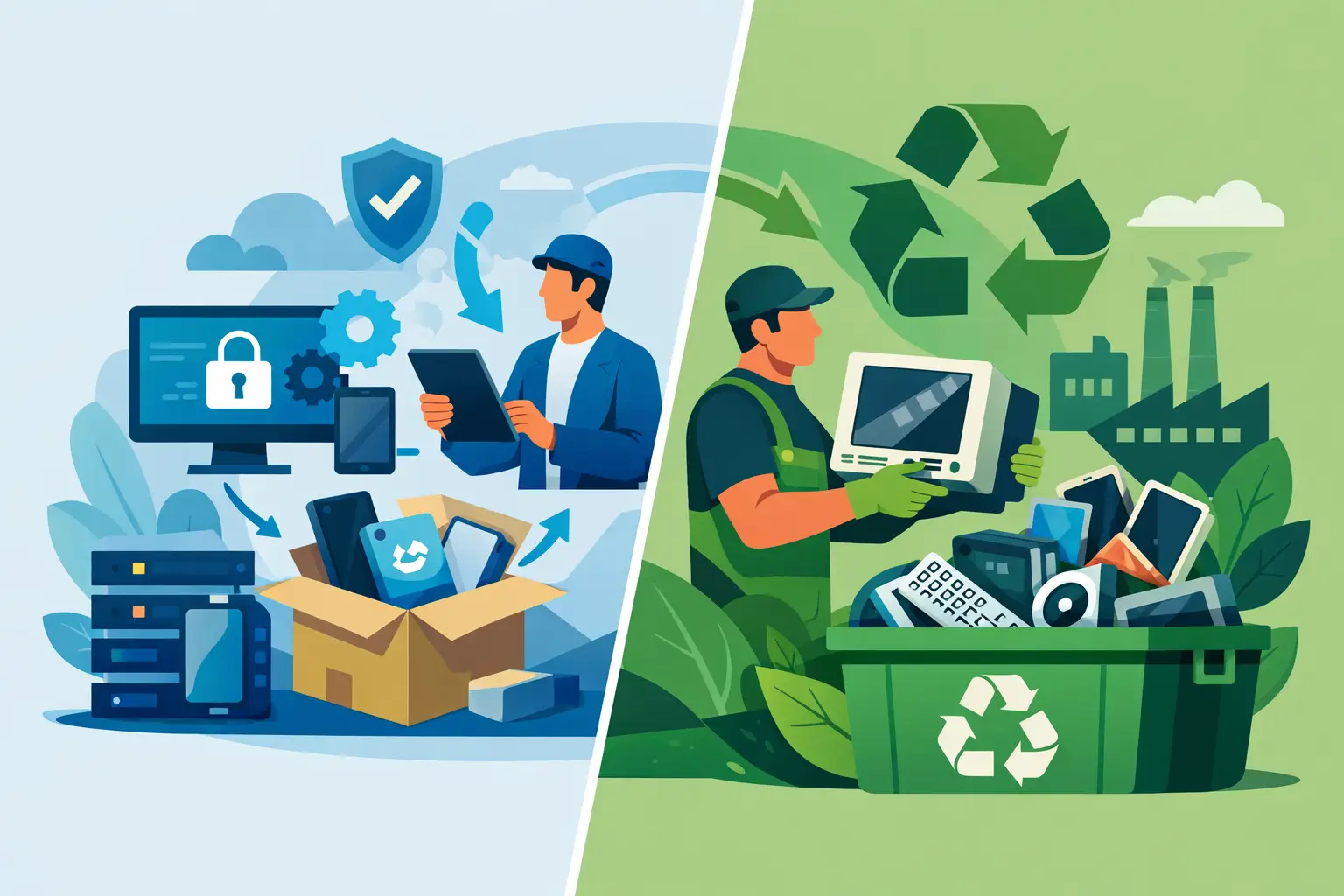
The simplest way to look at it is this: ITAD starts with the asset and its risks, while electronics recycling starts with the material and its proper end-of-life handling. In many real-world pickups, both happen together. A load may include resale-ready laptops, hard drives that need destruction, and obsolete peripherals that go straight to recycling.
When ITAD is the better fit
ITAD makes the most sense when your equipment still has potential value, contains storage media, or needs formal disposition records. That usually applies to desktops, laptops, servers, networking gear, tablets, and mobile devices coming out of business use.
A proper ITAD process typically includes serialized asset tracking, evaluation for reuse or buyback, data destruction, and reporting. For an IT manager or operations lead, that documentation is often as important as the physical pickup. It supports internal controls, audit requirements, and confirmation that retired devices did not leave the building without accountability.
This matters most during office relocations, data center refreshes, employee laptop rollouts, school technology upgrades, and lease-return cycles. In those situations, the equipment is not just “e-waste.” It is an inventory of assets with varying residual value, different data risks, and different disposition paths.
There is also a financial angle. Some devices can be liquidated or offset service costs if they retain market value. Not every load qualifies, and older or damaged equipment often does not, but organizations with newer business-grade hardware should not assume everything belongs in the scrap stream.
When electronics recycling is the right service
Electronics recycling is usually the right fit when equipment has little or no resale value, when the primary goal is clearing out obsolete material, or when the load includes a high volume of non-IT items and low-value peripherals.
That might include broken monitors, outdated accessories, miscellaneous cables, docking stations, mice, keyboards, fax machines, AV gear, and mixed office electronics. It can also include older computers and printers that are beyond practical reuse.
For facilities teams and office managers, the main priority is often convenience and compliant removal. They need a vendor that can pick up the material, handle it according to state and federal guidelines, and keep it out of the landfill. In those cases, recycling is not a lesser service. It is the appropriate service.
The trade-off is that standard recycling does not always provide the same level of asset-level reporting or value recovery analysis as a formal ITAD program. If you are disposing of ten pallets of mixed e-waste from several departments, that may be perfectly acceptable. If you are retiring 300 encrypted laptops assigned to employees, it probably is not.
Data security is where the gap becomes obvious
The biggest operational difference in ITAD vs electronics recycling is data handling.
ITAD is built around the fact that many business electronics store sensitive information. Laptops, desktops, servers, smartphones, SSDs, hard drives, and even some copiers and network devices may contain regulated, confidential, or proprietary data. That means the disposition process should include secure data wiping, physical destruction, or both, with documentation to match your policy.
Electronics recycling may include destruction services, but recycling by itself should not be treated as a data security plan. Too many organizations still assume that if a device is “going to recycling,” the data issue takes care of itself. It does not. If the device contains storage media, you need a clear process before it enters the recycling stream.
This is especially relevant for organizations subject to privacy obligations, internal retention rules, or vendor management standards. A vendor that can collect equipment is not automatically a vendor that can support secure data disposition in a way your compliance team will accept.
Compliance is not just about where the material ends up
Responsible recycling matters, but compliance starts earlier than final downstream processing. It includes pickup controls, handling procedures, hazardous material awareness, and records that show what happened to your equipment.
For Bay Area organizations, this can become complicated quickly because loads are often mixed. One pickup may include reusable laptops, dead batteries, networking gear, loose hard drives, and a few oversized devices that require special handling. A practical disposition plan accounts for each category instead of treating everything as one undifferentiated pile.
This is another area where ITAD can add structure. If your organization needs certificates of destruction, serialized reporting, or a documented chain of custody, those requirements should be defined up front. Recycling remains part of the process, but it is no longer the only concern.
On the other hand, not every office cleanout requires enterprise-level asset reporting. A small quantity of low-value peripherals or broken display equipment may only require compliant recycling and straightforward pickup logistics. The correct approach depends on the devices and the risk profile, not on a one-size-fits-all label.
Value recovery changes the decision
One reason organizations compare ITAD vs electronics recycling is cost. They want to know whether they are paying to remove equipment that still has value.
That question is fair, but the answer depends on age, condition, specs, brand, and quantity. Newer business-class laptops, servers, and network equipment may qualify for remarketing, buyback, or liquidation. Heavily used, incomplete, obsolete, or damaged devices usually do not.
A recycling-first approach can be efficient when value recovery is unlikely. An ITAD-first approach makes more sense when you have a large batch of recently retired assets that may still return something. The key is realistic evaluation. Chasing resale value on equipment with no viable secondary market wastes time. Sending reusable assets straight to scrap wastes money.
How to choose the right path for your organization
Start with three questions. Does the equipment contain data? Does it have likely resale value? Do you need asset-level documentation?
If the answer to any of those is yes, you are probably looking at an ITAD scope, even if part of the load ultimately gets recycled. If the answer to all three is no, standard electronics recycling may be enough.
It also helps to sort by category before scheduling pickup. Keep data-bearing devices separate from non-data-bearing equipment. Identify batteries, large printers, and specialty items that may have different handling requirements. If you manage multiple offices or campuses, consolidate where possible so the pickup is more efficient and easier to document.
For organizations with recurring refresh cycles, it is worth standardizing this process. A written internal workflow for retirement, collection, approval, and pickup reduces confusion and lowers the chance that old devices sit in closets for months. Delayed disposition creates storage issues, weakens inventory control, and extends data exposure for no good reason.
The practical reality is that most commercial pickups involve both services. Some assets are candidates for liquidation. Some need shredding or data destruction. Some are simply end-of-life electronics that should be recycled responsibly. A vendor that understands that mix can help you avoid oversimplifying the job.
If your team is staring at a room of retired equipment and calling all of it “e-waste,” pause there. The better question is not what to throw away. It is what needs to be tracked, what needs to be destroyed, and what still deserves a second life before it is recycled.