
A server room cleanup can look straightforward until someone asks what the retired equipment is worth. The choice between equipment buyback vs liquidation affects more than the recovery check. It affects how quickly space is cleared, who handles data-bearing devices, how much staff time the project requires, and whether the final disposition meets your organization’s compliance standards.
For Bay Area organizations replacing computers, servers, networking gear, and mobile devices in volume, neither option is automatically better. The right approach depends on the condition, age, quantity, market demand, and data risk of the assets involved.
Equipment Buyback vs Liquidation: The Core Difference
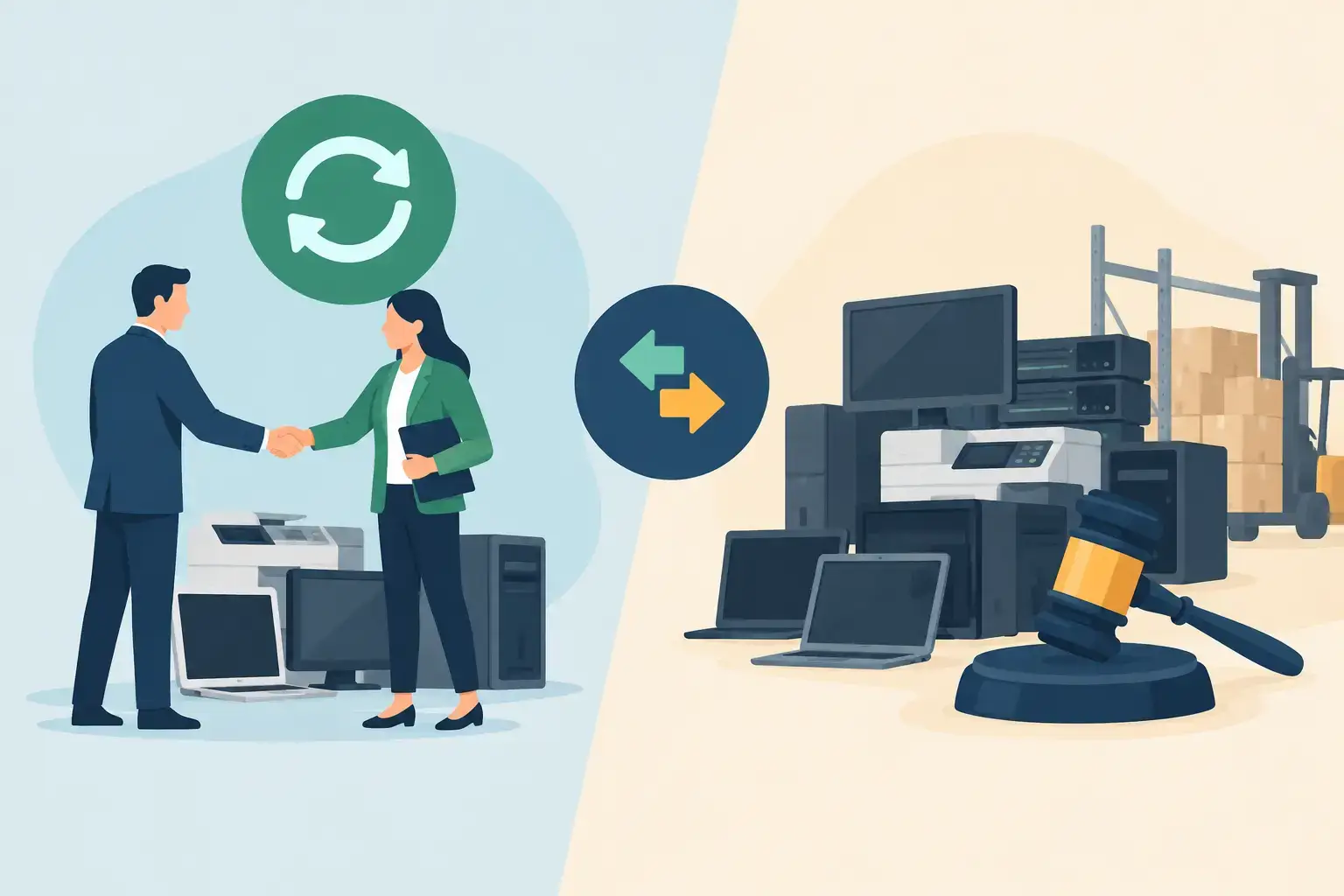
Equipment buyback is a direct transaction. A qualified buyer evaluates the assets, makes an offer, and purchases the equipment at an agreed price. Once the terms are accepted, the buyer takes possession and manages the downstream process according to the service agreement.
Liquidation is a sales process designed to recover value from assets through resale channels. Equipment may be sold individually, in lots, through brokers, or through other secondary-market channels. The organization receives the proceeds after applicable selling, handling, shipping, and service costs are deducted.
Put simply, buyback generally prioritizes speed and certainty. Liquidation generally pursues the highest possible market return, with less certainty about timing and final proceeds.
That distinction matters when an office move, technology refresh, lease expiration, or storage-room cleanup has a fixed deadline. A direct buyback can reduce the number of moving parts. Liquidation can make sense when assets have meaningful resale demand and the organization can accommodate a longer process.
When Equipment Buyback Is the Better Fit
A buyback is often the practical choice for organizations that need a clear disposition plan and a known value before equipment leaves the site. It works particularly well for standardized fleets of newer laptops, desktops, servers, switches, firewalls, tablets, and business-grade mobile devices.
The strongest buyback candidates are functional, complete, and commercially desirable. Equipment with current-generation processors, usable memory and storage, intact screens, power supplies, accessories, and no major physical damage is easier to evaluate and resell. Larger quantities of similar assets can also simplify pricing and logistics.
Buyback is not limited to equipment that is ready to be reused without work. A buyer may still assign value to items that require testing, refurbishment, parts harvesting, or responsible recycling. However, the offer will reflect the labor, risk, and downstream processing required.
For IT and facilities teams, the operational benefit is often as important as the purchase price. A direct transaction can provide a defined chain of custody, scheduled pickup, consolidated asset handling, and a faster path to clearing space. That can be valuable when employees are waiting for replacement equipment, a building is being vacated, or retired devices are accumulating in unsecured areas.
Buyback does have a trade-off. The offer reflects what the buyer can reasonably recover after testing, resale, transportation, compliance handling, and market risk. You may receive less than the theoretical price an individual device could bring through a consumer marketplace, but the organization avoids managing dozens or hundreds of separate sales.
When Liquidation May Produce Better Results
Liquidation is usually worth considering when equipment is relatively current, in strong working condition, and likely to attract multiple buyers. This may include high-spec workstations, enterprise servers with desirable configurations, networking equipment with active support demand, production hardware, or large quantities of matched devices.
A liquidation process may create more upside because equipment can be marketed to the buyers most likely to need it. The trade-off is that resale value is not always immediate or guaranteed. Market demand can change quickly, especially for IT hardware. A system that was valuable at the start of a refresh cycle may lose value while it waits to be listed, tested, repaired, or sold.
Organizations should also understand how liquidation fees are structured. Depending on the arrangement, costs may include testing, data sanitization, packing, freight, listing, storage, sales commissions, and unsold-item processing. A high expected resale value can look less attractive after these costs are accounted for.
Liquidation requires more internal attention as well. Someone may need to approve sale channels, review reports, track serial numbers, reconcile proceeds, and decide how long unsold assets should remain available. For a small set of valuable equipment, that effort may be justified. For a mixed room of aging desktops, monitors, cables, printers, and obsolete networking gear, it often is not.
Data Security Is Not Included by Default
Whether equipment is bought back or liquidated, data security must be addressed before the assets enter a resale or recycling stream. A device’s resale potential does not eliminate its data risk. In many cases, the equipment with the most value is also the equipment most likely to contain sensitive information.
Hard drives, solid-state drives, servers, laptops, mobile devices, network appliances, and copiers can retain business data, credentials, user profiles, logs, scanned documents, or customer information. Simply deleting files or resetting an operating system is not a sufficient disposal policy for many organizations.
Before approving a buyback or liquidation plan, establish whether data-bearing media will be wiped, removed, or physically destroyed. Confirm who performs the service, how custody is documented, and what documentation will be provided after completion. If physical shredding is required by your policy, contract, customer commitments, or regulatory obligations, the recovery value of a device may change because the storage media cannot be resold.
This is not necessarily a reason to avoid buyback or liquidation. It is a reason to separate the value of reusable equipment from the security requirements of its data-bearing components. A laptop may retain resale value after its drive is removed and destroyed. A server chassis, memory, processors, and network cards may still have market value even when all drives are shredded.
Evaluate the Entire Load, Not Just the Best Assets
Most business technology cleanouts are mixed loads. A company may have 50 current laptops with resale value, alongside aging monitors, broken desktops, keyboards, cables, batteries, printers, and outdated servers that have little or no resale market. Looking only at the best assets can lead to unrealistic expectations about the total project value.
A practical assessment considers the complete inventory and the cost of handling each category. Reusable assets can support a buyback offer or liquidation project. End-of-life material must be recycled through a compliant process. Specialized items, such as large-format printers and copy machines, may require separate handling because of their size, components, and transportation needs.
To receive a useful evaluation, prepare basic details about the load, including:
- Equipment types, manufacturers, and model numbers
- Approximate quantities and condition
- Whether devices have power supplies, drives, or accessories
- Pickup location, floor access, loading dock availability, and deadlines
Clear information helps determine whether the project is suited to direct buyback, liquidation, recycling, or a combination of all three.
A Combined Approach Often Makes Sense
The choice does not always need to be all or nothing. Many organizations use a blended disposition plan: sell the assets with recoverable value, securely destroy data-bearing media where required, and recycle the remaining equipment responsibly.
For example, an office may have a recent fleet of laptops, several usable network switches, old monitors, damaged desktops, and boxes of cables. The laptops and switches may qualify for value recovery. The monitors, damaged units, and miscellaneous electronics may be routed to compliant e-waste recycling. This approach avoids holding low-value material in storage while preserving the financial return available from better assets.
The key is to set expectations early. An asset-disposition provider should explain which items have resale potential, which require recycling, what services are included, and whether pickup qualifies for no-cost collection. Free pickup can be available for qualified commercial loads, but eligibility depends on the volume and mix of equipment.
Questions to Ask Before You Choose
Before selecting a buyback or liquidation route, ask for a clear explanation of pricing, timelines, data handling, reporting, and final disposition. If an offer appears unusually high, ask what assumptions it relies on. Does it depend on all equipment passing tests? Are fees deducted later? What happens to devices that do not sell or are found to be nonfunctional?
Also confirm how equipment will be transported and processed. Responsible electronics recycling requires more than removing equipment from the premises. Your organization should know that non-reusable materials will be handled in accordance with applicable state and federal requirements, rather than sent to a landfill or improperly exported.
For organizations managing recurring technology refreshes, a consistent disposition policy is usually more valuable than chasing the highest possible price on every device. Define data-destruction requirements, asset ownership rules, approval thresholds, and documentation expectations before the next storage room fills up. That makes the next pickup faster, safer, and easier to manage.